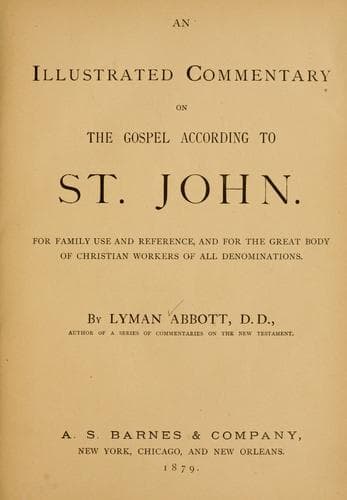
An illustrated commentary on the Gospel according to St. JohnAbbott, Lyman
Religion
An illustrated commentary on the Gospel according to St. John
Abbott, Lyman
Bible. John -- Commentaries
The indications are not less clear that the writer, whoever he may
have been, was not himself a sharer in Jewish prejudices. Jew he may
have been; an intolerant Jew he certainly was not. He is familiar with
the Pharisees and with the Pharisaic law, but he has no sympathy with
the one and no admiration for the other. We can hardly be mistaken in
thinking that his native prejudices are adverse rather than favorable
to the inhabitants of Judea. More than any of the other Evangelists
his language respecting them indicates his aversion to them. He is the
Evangelist who reports the mobs in Jerusalem against Jesus, and the
secret counsels for his assassination, and the deliberate judgment of
Caiaphas that it is better for the rulers to kill the Galilean Rabbi
than to hazard their own offices, and the persistent persecution of
Jesus; he it is who with delicate sarcasm stigmatizes Caiaphas as
high-priest for “that same year;” the very language which he employs in
describing the religious festivals of Judea as “feasts of the Jews,”
indicates an author not in sympathy with the religious formalism
of Judea; the very phraseology with which he characterizes the
reluctance of the Jews to enter into Pilate’s judgment-hall, indicates
a writer having little sympathy for the formalism which was never a
characteristic of the Galilean Jews, and always was a characteristic of
the more intense and bigoted Jews of the Syrian province of Judea.[18]
Nor can we be mistaken in surmising that the author was, by nature and
temperament, ardent, impulsive, vehement. The intensity of his nature
has been tamed by age, experience or grace, or the three combined;
but the indications of his native character crop out in occasional
utterances. The records of Matthew, Mark, and Luke are absolutely
colorless. They are without epithets. Their simple and artless
narrative is left to produce its own impression. This is less true of
the Fourth Gospel than of the other three. The intense indignation
which the writer feels against Judas Iscariot, he is at no pains to
conceal. He it is who reports Jesus as declaring early in his ministry,
One of you is a devil; he it is who characterizes Judas Iscariot
as a thief; he who twice declares that Satan entered into Judas
Iscariot.[19] These are the most notable exhibitions of his feelings;
but one can hardly read through the entire narrative without realizing
in its tone and spirit the evidence that the author was a man of
intense and passionate earnestness, kept under marvelous self-restraint.
Public-domain text, read in full here on John Shaqi.
Reviews
Reviews
No reviews yet
Be the first to share your thoughts on this work.
Join the Discussion
Join the discussion
Sign in to leave a comment or review.
Sign InorCreate an account