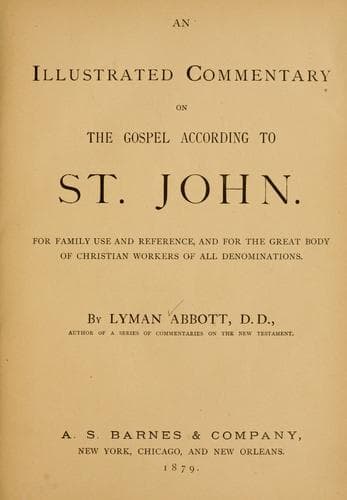
An illustrated commentary on the Gospel according to St. JohnAbbott, Lyman
Religion
An illustrated commentary on the Gospel according to St. John
Abbott, Lyman
Bible. John -- Commentaries
Now, so far as our limited knowledge enables us to judge, John’s life
and character remarkably correspond with these indications of the
Gospel which was so long unanimously attributed to his pen. His
parents were well-to-do Galileans, and he probably received a fair
education in his childhood; his early education as a Galilean would
have given him familiarity with Jewish customs, and yet would
prejudice him against rather than in favor of the inhabitants of
Judea; his later and prolonged residence in Ephesus, of all Greek
cities the most Oriental, would have made him familiar with the best
Greek culture, and with the mystic philosophy of the Greco-Oriental
school; that he possessed a vehement nature is evident from his
original title of Son of Thunder; his receptive disposition and his
intense love for Jesus might have been expected to tame that nature,
without eradicating from his writings all indications of its
existence; of all the disciples the most courageous and the most
sympathetically intimate with the subject of his biography, he was of
them all the one to adhere to Jesus in his dangerous ministry in
Jerusalem, and the one therefore to record what all the others have
omitted; he was also the one to interpret Christ’s actions by his own
suggestion of Christ’s unuttered thoughts; writing after the other
Gospels had been written and were already being widely circulated, his
omission of events and teachings which they had recorded is not only
explicable, but natural and to be anticipated; finally, writing after
the destruction of Jerusalem, after the dispersion of the Jews had
begun, after the descent of the Holy Spirit had interpreted the
mystical promises of another Comforter, after churches had been
organized as far west as Rome in which Gentile and Jew met on equal
terms, after, in a word, the history of the church had interpreted the
prophecies and instructions of its Lord, it would have been strange
indeed if he had not given a deeper, truer, and more catholic
exposition of Christ’s Gospel than could have been written during the
first half-century in Palestine, by those whose comprehension of
Christ’s, teaching had not been broadened by residence in a foreign
land and an observation of Christ’s redeeming work in a pagan
community.
=Other hypotheses.= The conclusion to which a consideration of the
external and internal evidence brings the candid student is confirmed
by a consideration of the alternative hypotheses presented to him.
These are many in form; for it is a significant fact that while those
who believe in the authenticity of the Fourth Gospel are entirely
agreed in respect to its authorship, and the time and place of its
composition, those who disbelieve in its authenticity are not agreed
among themselves respecting either. But in general their various
opinions may be reduced to two classes.
Public-domain text, read in full here on John Shaqi.
Reviews
Reviews
No reviews yet
Be the first to share your thoughts on this work.
Join the Discussion
Join the discussion
Sign in to leave a comment or review.
Sign InorCreate an account