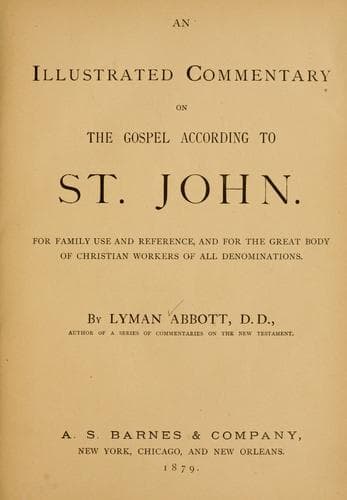
An illustrated commentary on the Gospel according to St. JohnAbbott, Lyman
Religion
An illustrated commentary on the Gospel according to St. John
Abbott, Lyman
Bible. John -- Commentaries
The first is that the Fourth Gospel is the work of a Gentile Christian
writing in the third century. Confessedly this Gospel purports to be
written by an eye and ear witness. Confessedly it was unanimously
attributed to the Apostle John in the third century. Confessedly it is
without a peer in literature, ancient or modern, sacred or secular,
Christian or pagan, in the purity of its doctrine, the moral elevation
of its style, and the spirituality of its atmosphere. This hypothesis
asks us to believe that it is the work of a deliberate ecclesiastical
forger, with so little conscience that he neither hesitated to assume
the pen of an Apostle nor to attribute to Jesus fictitious discourses
and imaginary miracles, yet with so much conscience that he would not
put an Apostle’s name to his composition, but left its authorship to
be inferred by a self-deluded public; written too by a forger who was
so skillful that he deceived the whole contemporaneous church, all
sects and sections, Jewish and Gentile, Greek, Roman, and African,
orthodox and heretic, and yet who was such a bungler that the gross
discrepancies of his account, contrasted with that of the other three
evangelists, make his fraud palpable to the ecclesiastical and literary
critics of the nineteenth century. This hypothesis demands so great
an exercise of credulity that sober critics of even the rationalistic
school are generally abandoning it, or have already done so. This
opinion may be already characterized as a thing of the past.
The other hypothesis is more plausible and captivating. This is that
the Fourth Gospel was written by an amanuensis or a disciple of the
Apostle John, that its essential facts were derived from him, that it
was written in his old age, that his recollection was already growing
dim and his reports of the words of Jesus are unconsciously modified
by his philosophy and experience, and that these reports are still
further modified by the free pen of the amanuensis or the disciple who
perfected the written record; and it is urged that this hypothesis
explains both verbal peculiarities and the title given to it from
early ages, viz., not the Gospel of John, but the Gospel according to
John.[20]
Public-domain text, read in full here on John Shaqi.
Reviews
Reviews
No reviews yet
Be the first to share your thoughts on this work.
Join the Discussion
Join the discussion
Sign in to leave a comment or review.
Sign InorCreate an account