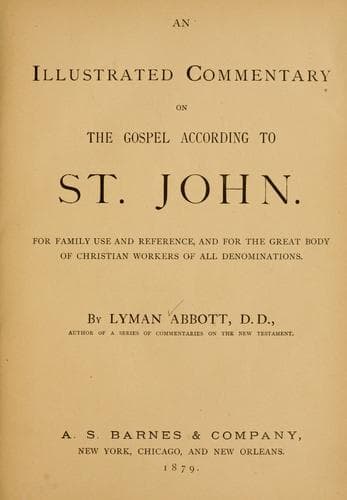
An illustrated commentary on the Gospel according to St. JohnAbbott, Lyman
Religion
An illustrated commentary on the Gospel according to St. John
Abbott, Lyman
Bible. John -- Commentaries
I. _The facts._ (1) The passage in question is wanting in many if not
most of the best MSS.; pre-eminently the Alexandrian, the Vatican, the
Ephraem, and the Sinaitic. Of the great manuscripts, the Cambridge
alone contains it. (2) It is transposed in some documents; one places
it in John after 7:36; ten at the end of John; four in the Gospel of
Luke, at the close of ch. 21. (3) In those MSS. which contain it there
are great variations. Griesbach distinguishes three entirely different
texts; the ordinary text, that of the Cambridge MS., and that
resulting from a collection of other MSS. Alford gives these three in
his Greek Testament. Sixty various readings are found in these twelve
verses. “No genuine apostolic text has ever undergone such
alterations.”--(_Godet._) (4) The style and character of the narrative
is strikingly unlike John. These differences are partly verbal, and
are apparent only to the Greek scholar. Ten expressions are given by
Meyer as non-Johannean. They are partly structural, and as easily
recognized by the English reader as by the Greek scholar. Such are the
propounding of a question concerning the law to tempt Christ, and the
departure of Christ at night from the temple, both of which agree
rather with the Synoptics’ account of the last sojourn in Jerusalem
than with John’s account of this period of Christ’s ministry. If the
account is omitted altogether, the discourse in ch. 7 and that in ch.
8 appear to be in close connection; the interruption of this incident
is not very clearly cognate to either discourse; and it is not John’s
habit to narrate incidents that are not connected with and do not lead
to some discourse of the Lord. (5) Among the fathers Origen,
Chrysostom, Theophylact, and Tertullian are altogether silent about
the passage; Jerome, Ambrose, and Augustine recognize it as authentic;
among critical scholars Lucke, Tholuck, Olshausen, De Wette, Luthardt,
Hengstenberg, Schenkel, Godet, Lachmann, Tischendorf, Alford, and
Schaff apparently agree in regarding it as an addition by some other
hand to John’s Gospel; Bengel and Hilgenfeld are the only scholars of
widely recognized reputation who defend its Johannean authorship. (6)
But though the narrative is unlike John, the act is very like Jesus.
The whole scene possesses an air of historic reality: the arrest of
the woman, the demand on Jesus, the Pharisaic contempt for public
morality in obtruding the crime and the criminal on public attention
in the temple courts; the attempt to entrap Jesus; the skill of his
reply; the subtle recognition of the woman’s shame and despair, and
the gentle avoidance of adding to it, in turning the public gaze from
her to himself by writing on the ground; the final confusion of the
Pharisees and release of the woman. It is impossible to believe that
any monkish mind conceived of this and added it to the narrative. The
deed is the deed of Christ, whether or no the record is the record of
John.
Public-domain text, read in full here on John Shaqi.
Reviews
Reviews
No reviews yet
Be the first to share your thoughts on this work.
Elsewhere in the archive
Join the Discussion
Join the discussion
Sign in to leave a comment or review.
Sign InorCreate an account