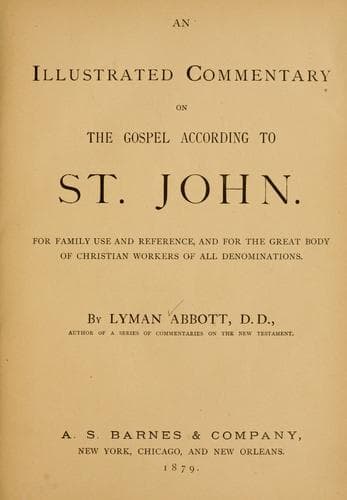
An illustrated commentary on the Gospel according to St. JohnAbbott, Lyman
Religion
An illustrated commentary on the Gospel according to St. John
Abbott, Lyman
Bible. John -- Commentaries
In support of this opinion there is quoted an ancient legend found in
the canon of Muratori (A. D. 175), which runs as follows: “The fourth
of the Gospels is by the disciple John. He was being pressed by his
disciples and (fellow) bishops, and he said, ‘Fast with me this day,
and for three days; and whatsoever shall have been revealed to each one
of us, let us relate it to the rest.’ In the same night it was revealed
to the Apostle Andrew that John should write the whole in his name,
and that all the rest should revise it.” It must suffice to say of
this opinion that in its most pronounced form it is wholly unsustained
by evidence. It is ingenious, but not substantial. Doubtless the
reports of Christ’s disciples are not verbatim. Doubtless we have
in many instances the sentiments of Christ embodied in the words of
John. Possibly some glosses and explanations added originally by an
amanuensis or scribe may have become incorporated in the narrative.[21]
But that the book is in no sense a composite production, that it is the
work of one not of many minds, that we have essentially the portrayal
of the life and character of Jesus by a single author, is evident on
even a casual perusal, and still more on a careful analysis of the work.
=Discourses of Jesus.= The Gospel of John abounds with reports of the
discourses of Jesus; it is more a report of his discourses (λόγια) than
of his works (ἔργα); the miracles reported are generally only a text
for a discourse which follows. The student, passing from the Sermon on
the Mount in Matthew, or the parables in Perea, in Luke, to the sermon
on the Bread of life at Capernaum (John, ch. 6), or on the Good
Shepherd, at Jerusalem (John, ch. 10), feels the difference between
them, a difference chiefly in the phraseology employed, sometimes in
the phases of truth taught, but never amounting to a contradiction in
the essential teaching. The same doctrine respecting the authority of
Christ is conveyed by Matt. 11:27, and John 5:19-30; the same truth as
to the nature and necessity of a new and divine life in the soul is
expressed in Mark 4:26-29, and in John 6:50-58; similar parallels in
essential truth may be found in the synoptics to all that is taught in
the Fourth Gospel; but the form of expression is strikingly different.
Thus, in the study of the Fourth Gospel, the question is constantly
pressed upon the student, how far the reports of Christ’s addresses by
John are to be regarded as reported in the words of Christ.
Public-domain text, read in full here on John Shaqi.
Reviews
Reviews
No reviews yet
Be the first to share your thoughts on this work.
Join the Discussion
Join the discussion
Sign in to leave a comment or review.
Sign InorCreate an account