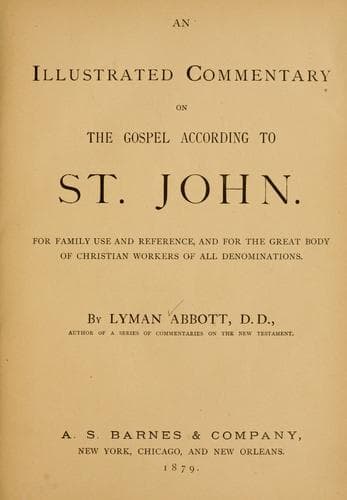
An illustrated commentary on the Gospel according to St. JohnAbbott, Lyman
Religion
An illustrated commentary on the Gospel according to St. John
Abbott, Lyman
Bible. John -- Commentaries
John opens his narrative by an introduction, in which he borrows the
mystical language of Oriental philosophy to characterize Jesus, whom
he describes as the Life, the Light, the Word; he reports John the
Baptist, not as the preacher of the baptism of repentance, but as a
prophet of the Lamb of God which taketh away the sin of the world
(ch. 1); in his account of the conversation with Nicodemus (ch. 3),
he points out the origin of the spiritual life which Christ imparts to
the believer, “Ye must be born from above;” in his report of the
conversation with the Samaritan woman, and of the discourse at
Capernaum (chaps. 4, 6), he indicates the means by which that life is
sustained, by appropriating faith in Christ; and in his record of the
intermediate discourse at Jerusalem (ch. 5), the basis for that faith
in Christ’s own portrayal of himself as the Son and manifestation of
God the Father; in his report of the discourses in the Temple, he sets
forth in a different form the same truths. (ch. 7), declares the
emancipation from bondage which faith in the Son achieves for the
soul, contrasts it with the life of bondage unto sin (ch. 8), and
describes the safety and security of the disciples, a security
purchased by the death of their Lord (ch. 10); he narrates the
resurrection of Lazarus, therein portraying Jesus as the resurrection
and the life (ch. 11); he reports those words of Jesus at the Last
Supper, the full meaning of which no Christian experience has ever yet
fully sounded, in which is promised to the believing disciple a
spiritual manifestation of God to the soul, an abiding life of God in
the soul, and a joyful realization of all spiritual fullness in God by
the soul (chaps. 14, 15, 16); he records the only reported
intercessory prayer of the Lord for his disciples (ch. 17), the burden
of which is, “As thou Father art in me and I in you, that they also
may be one in us;” in the account of the Passion he alone gives the
short dialogue between Jesus and Pilate, in which the Lord declares
himself a king and his kingdom one of everlasting truth; and in his
account of the resurrection (ch. 20), he tells the story of Thomas’s
unbelief and of Christ’s warm commendation of “those who have not seen
and yet have believed.” Life through faith--this is the burden of
John’s Evangel; Jesus Christ the Life-giver, the disciple of Jesus
Christ the recipient of a new life--this is the good news which
constitutes the Fourth Gospel.
Public-domain text, read in full here on John Shaqi.
Reviews
Reviews
No reviews yet
Be the first to share your thoughts on this work.
Join the Discussion
Join the discussion
Sign in to leave a comment or review.
Sign InorCreate an account