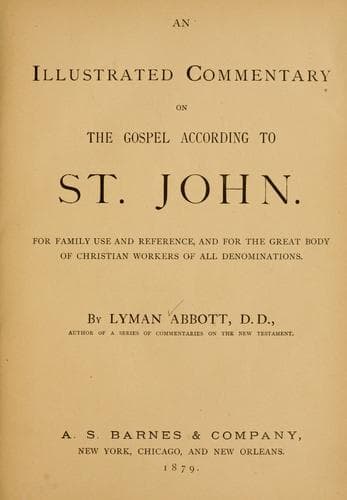
An illustrated commentary on the Gospel according to St. JohnAbbott, Lyman
Religion
An illustrated commentary on the Gospel according to St. John
Abbott, Lyman
Bible. John -- Commentaries
=When and where and for whom written.= A very ancient testimony, that
of Irenæus, repeated by Jerome and later writers, fixes the place of
publication at Ephesus. This accords with the character of the Gospel
itself. The Oriental phraseology employed in the first chapter
especially, but also in less degree in other portions of the Gospel,
indicates that it was written in a city where Oriental philosophy had
a strong hold; and of all Greek cities Ephesus was the most Oriental.
Moreover, an ancient and apparently trustworthy tradition makes this
city the home of John in his later years. The time of its composition
is uncertain. Irenæus states that it was the latest written of the
four Gospels. The character of the Gospel, as we have seen, confirms
this tradition. The book bears marks of being written in old age; it
is apparently the production of a ripened Christian experience. Alford
fixes the date as between A. D. 70 and A. D. 85; Macdonald, A. D. 85
or 86; Godet, between A. D. 80 and 90; Tholuck, not far from A. D.
100.
[1] For same account in detail of these discussions, see
Godet’s Commentary on St. John’s Gospel, Intro., Chap.
II.
[2] Comp. Matt. 27:56 with Mark 15:40.
[3] Luke 8:3.
[4] Matt. 20:20, 21; Mark 15:40; 16:1.
[5] John 7:15, 48.
[6] 1 Kings 9:10, 11. See Abbott’s Dict. of Rel. Knowledge,
art. _Galilee._
[7] See John 1:35-37, notes; Matt. 4:21; 10:2; 17:1; 20:20;
26:37; Mark 5:37; John 13:23; 14:26, 27; 20:1-8; Acts
3:1, etc.; 8:14-25; Gal. 2:9.
[8] Acts, ch. 19; ch. 20:17-38.
[9] Mark 3:17; Luke 9:49-56; Matt. 20:20; John 18:15; 19:26;
Acts 4:19, 20.
[10] Matt. 16:22; John 14:5, 8, 22; John 12:4, with Matt. 26:14.
[11] John 5:16, 18; 7:13, 19; 8:40, 44, 59; 9:22, 28; 18:31, etc.
[12] See John 2:6, 13; 5:1; 6:4; 7:2; 8:17; 10:34; 15:25;
19:40, 42.
[13] John 1:14; 19:35; 21:24; 1 John 1:1-3.
[14] John 1:36, 38; 4:6; 6:10; 12:3; 13:30; 18:18.
[15] John 12:27, 28; 13:3; chaps. 14-16.
[16] John 1:19; 3:16; 6:37; chaps. 4, 5, 10, 14, 15.
[17] John 2:6; 5:1; 6:4; 7:2; 18:28; 19:40.
[18] See John 7:1, 19, 25, 32; 8:6, 59; 9:22; 10:31; 11:49.
[19] John 6:70, 71; 11:6; 13:2, 27.
[20] The student will find this hypothesis urged with great
literary ingenuity by Matthew Arnold, in “God and the
Bible.”
[21] See John 5:4, and note there.
Public-domain text, read in full here on John Shaqi.
Reviews
Reviews
No reviews yet
Be the first to share your thoughts on this work.
Join the Discussion
Join the discussion
Sign in to leave a comment or review.
Sign InorCreate an account