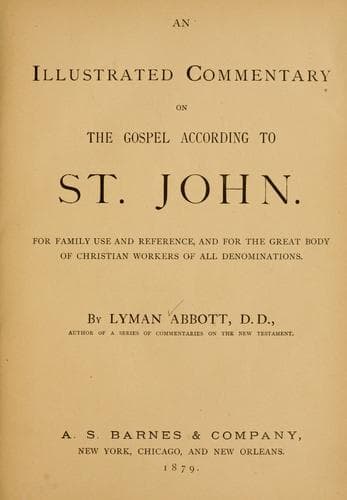
An illustrated commentary on the Gospel according to St. JohnAbbott, Lyman
Religion
An illustrated commentary on the Gospel according to St. John
Abbott, Lyman
Bible. John -- Commentaries
=31-33.= The moral power of Christ is singularly illustrated by the
manner in which he restrains the mob by his voice and compels them to
answer his question. That question implies that punishment is due only
to wrong actors, and he asks them before they execute sentence, to
designate any wrong that he has done. The question is thus analogous
to that of ch. 8:46, “Which of you convinceth me of sin.”--Blasphemy
was a regularly recognized crime under Jewish law; it consisted in any
endeavor to draw away the allegiance of the people from the one true
God, and answered to treason with us, Jehovah being under the
theocracy, the Supreme head of the nation (see Matt. 12:32, note). The
reply of the Jews to Christ’s question plainly shows how they regarded
his declaration, “I and my Father are one,” not as indicating mere
unity in spirit and purpose, but also in power and essential being.
This is not indeed conclusive, for the Jews constantly misunderstood
Christ; but it is an indication of his meaning. One practical lesson
of the unity of the Godhead, of Christ and the Spirit with the Father,
is eloquently presented by Maurice: “The unity of the Father and the
Son is the only ground of the unity between the Shepherd and the
sheep; undermine one and you undermine both * * * *. Do you think
sects would last even for an hour, if there was not in the heart of
each of them a witness for a fellowship which combinations and
shibboleths did not create, and which, thanks be to God, they cannot
destroy. The Shepherd makes his voice to be heard through all the
noise and clatter of earthly shepherds; the sheep hear his voice and
know that it is calling them to follow him into a common fold where
all may rest and dwell together; and when once they understand the
still deeper message which he is uttering here, and which the old
creeds are repeating to us, ‘I and my Father are one;’ when they
understand that the unity of the church and the unity of mankind
depends on this eternal distinction and unity in God himself, and not
upon authority or decrees of any mortal pastor, the sects will crumble
to pieces, and there will be in very deed, one flock and one
Shepherd.”
34 Jesus answered them, Is it not written in your law, I
said, Ye are gods?
35 If he called them gods, unto whom the word of God came,
and the scripture cannot be broken;
36 Say ye of him, whom the Father hath sanctified,[420] and
sent into the world, Thou blasphemest; because I said, I
am[421] the Son of God?
[420] ch. 6:27; Isa. 11:2, 3; 49:1, 3.
[421] Phil. 2:6.
Public-domain text, read in full here on John Shaqi.
Reviews
Reviews
No reviews yet
Be the first to share your thoughts on this work.
Elsewhere in the archive
Join the Discussion
Join the discussion
Sign in to leave a comment or review.
Sign InorCreate an account