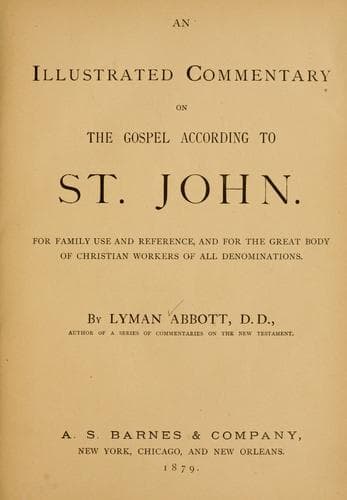
An illustrated commentary on the Gospel according to St. JohnAbbott, Lyman
Religion
An illustrated commentary on the Gospel according to St. John
Abbott, Lyman
Bible. John -- Commentaries
From the earliest ages the ablest minds have been perplexed by the
problem how to reconcile faith in an all-wise, all-powerful, and
all-benevolent Creator, with the fact of a creation full of sin and
suffering. One of the ablest thinkers of modern times (John Stuart
Mill) has declared the problem insoluble, and from the facts of
creation has deduced the conclusion that the Creator is neither
all-wise, all-powerful, nor all-good; to use his own words respecting
the Creator, “his wisdom is possibly, his power certainly limited,
and his goodness, though real, is not likely to have been the only
motive which actuated him in the work of creation.”--(_Three Essays in
Religion._) Oriental philosophy, pondering this problem, proposed for
its solution an hypothesis which to a Western mind seems singularly
puerile and fantastic, and yet which, in slightly different forms,
gained, at one period in the world’s history, an acceptance quite as
widespread as any form of philosophy or theology of to-day. This
hypothesis, however modified in form, was in essence this, that the
evil in the world came not from the Creator, but from some other and
inferior Being. In the Persian religion there were two deities, a good
and an evil god, Ormuzd and Ahriman, struggling with each other for
the supremacy. In the Chaldean philosophy Light was the soul of the
universe and the Original First Cause; in the lower realms, far below
the space filled with pure and unapproachable light, were darkness,
night, and all forth-springing evils, which either the Supreme Light
regarded it beneath his dignity to contend with, or which were
indestructible and could only be confined within narrow limits, not
destroyed. In the Hindoo philosophy, the Great First Cause, the
beatific Brahm, lived in perpetual repose, in a supreme and serene
indifference to all things. From him, by emanations, proceeded lesser
deities, and from these, by a process more or less remote, a corrupt
creation. At the beginning of the Christian era, Alexandria, founded
by and named in honor of Alexander the Great, was one of the
intellectual centres of the world. Here was gathered a library of over
700,000 volumes; here congregated Oriental dreamers, Greek philosophers,
and Jewish religionists. Here, in the third century before Christ, was
translated into the Greek language the Old Testament Scriptures. Here
about 20 B. C., was born Philo, a Jew, of a priestly family, a
philosopher and _litterateur_, and a voluminous writer. He was not an
original thinker; his works are therefore all the more valuable as a
reflection of the current mystical philosophy of his age and school.
This dreamy philosophy it is difficult to translate into modern forms
of thought. So far as this can be done, it may be said to have
involved the following statements: God is simply the absolute,
unchangeable Existence, incomprehensible, inconceivable, yet ever to
be the object of our thoughts and meditations. He could not come
Public-domain text, read in full here on John Shaqi.
Reviews
Reviews
No reviews yet
Be the first to share your thoughts on this work.
Join the Discussion
Join the discussion
Sign in to leave a comment or review.
Sign InorCreate an account