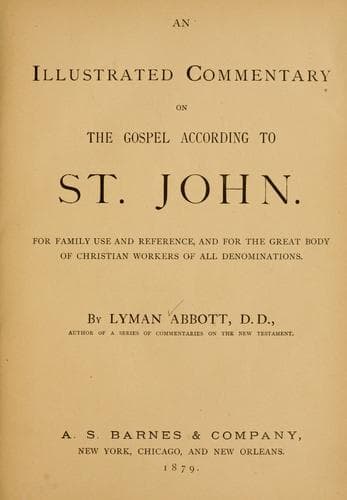
An illustrated commentary on the Gospel according to St. JohnAbbott, Lyman
Religion
An illustrated commentary on the Gospel according to St. John
Abbott, Lyman
Bible. John -- Commentaries
directly into contact with matter without losing something of his
ineffable excellence. Hence he gave forth certain divine powers or
influences, “incorporeal potencies,” which surround God as the members
of a court surround an earthly monarch. The highest of these is the
divine Logos or Word of God. Through this Word the world was created,
and to the influence of the inferior potencies the evils of the world
must be attributed. Again, borrowing the imagery of the Chaldeans,
Philo conceives of God as the pure and absolute Light, the original
source of effulgence, the Logos or Word as the nearest circle of light
proceeding from it, and each separate power as a separate ray, fading
more and more away into darkness, as it becomes removed from the
original source and centre. From this philosophy was later developed
that peculiar and incomprehensible form of thought known as
Gnosticism. This Gnostic philosophy, which reached its climax in the
second century after Christ, undertook to describe in detail all the
emanations from the original inconceivable deity; Reason, the Word,
practical Wisdom, theoretical Wisdom, Power, Light, Life, were all
lesser deities. The God of the Jews was one of these lower deities;
Jesus Christ was a higher deity--the Reason according to some, the
Word according to others, who came to deliver the world from its
subjection to the inferior deity, and who entered the body of Jesus at
his baptism, and departed from it just before his crucifixion. Whether
John was acquainted with the writings of Philo we do not know; but he
was certainly familiar with this Gnostic philosophy. It had already
begun to enter into and corrupt the Christian church during the
lifetime of Paul, whose writings contain frequent references to
different phases of it (e. g., Col. 2:18; 1 Tim. 4:1-4; 2 Tim.
2:16-18); Ephesus, a city of luxury, effeminacy and superstition
(Acts, ch. 19, notes), was a centre of this philosophy; in Paul’s
address to the elders of the church at Ephesus (Acts 20:29, 30), and
in his letter to Timothy, first bishop of that church (subs. to 2
Tim.), he especially warns against it (2 Tim. 2:16-18; 3:8, 9); and
Ephesus was John’s residence, and probably the city in which he wrote
his Gospel. (See Introduction.)
Public-domain text, read in full here on John Shaqi.
Reviews
Reviews
No reviews yet
Be the first to share your thoughts on this work.
Join the Discussion
Join the discussion
Sign in to leave a comment or review.
Sign InorCreate an account