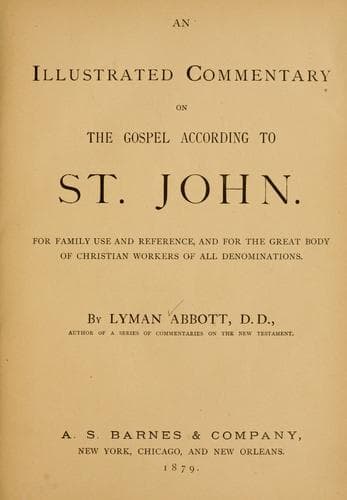
An illustrated commentary on the Gospel according to St. JohnAbbott, Lyman
Religion
An illustrated commentary on the Gospel according to St. John
Abbott, Lyman
Bible. John -- Commentaries
=38, 39. Jesus * * * saith unto them, What seek ye?= Not because he
was ignorant of their purpose, for he knew what was in man (ch. 2:25;
comp. Mark 2:8, etc.); but because he would draw them out. In a
similar manner he opens conversation with the woman at the well (ch.
4:10, 16), with the disciples fishing at the sea of Galilee (ch.
21:5), and with the disciples on their way to Emmaus (Luke 24:17).
Christ _as a conversationalist_ is a study for the Christian. Observe
how he opens the way and leads on to familiar acquaintance,
first by his question, then by his invitation, finally by his
hospitality.--=Rabbi * * * Master.= Rather, _teacher_, or _doctor_.
Rabbi is a Hebrew word; _teacher_ (διδάσκαλος) is its Greek
equivalent. John, writing for the Gentile world, habitually translates
the Hebrew phrases into their Greek equivalents.--=Where dwellest
thou?= They are timid and dare not, or at least do not, express their
whole desire. Often in the spiritual reticence, so common to the first
experiences of the awakened soul, its real aspirations after truth are
concealed beneath an assumed curiosity respecting some indifferent
matter. Christ meets this non-pertinent if not impertinent curiosity
with an invitation which attaches the two inquirers to him for
life.--=Come and see.= Rather, _Come and ye shall see_. This is the
best reading, and is given by Alford, Meyer, Tischendorf, Tregelles,
etc. (ὄψεσθε not ἴδετε).--=And abode with him that day.= For the rest
of the day.--=For it was about the tenth hour.= Reckoning from 6 A.
M., according to Jewish fashion, this would make it 4 P. M. Observe,
as indicative of the Evangelist John’s character, and of the force of
the impression made on him from the outset by Christ, that he
remembered not only the day, _but the very hour_, of his first
interview with his subsequent Lord. This, too, is one of those minute
touches which would not be found in either a mythical tradition or an
ecclesiastical forgery.
40 One of the two which heard John _speak_, and followed
him, was Andrew, Simon Peter’s brother.
41 He first findeth his own brother Simon, and saith
unto him, We have found the Messias, which is, being
interpreted, the Christ.
42 And he brought him to Jesus. And when Jesus beheld him,
he said, Thou art Simon the son of Jona: thou[57] shalt be
called Cephas, which is by interpretation, A stone.
[57] Matt. 16:18.
Public-domain text, read in full here on John Shaqi.
Reviews
Reviews
No reviews yet
Be the first to share your thoughts on this work.
Elsewhere in the archive
Join the Discussion
Join the discussion
Sign in to leave a comment or review.
Sign InorCreate an account