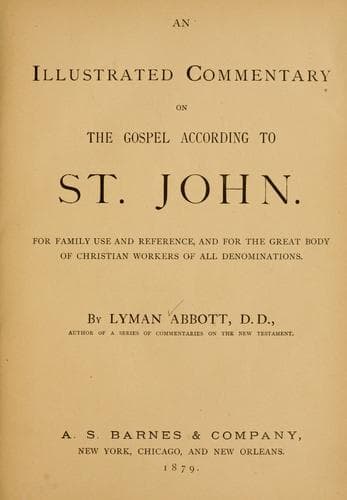
An illustrated commentary on the Gospel according to St. JohnAbbott, Lyman
Religion
An illustrated commentary on the Gospel according to St. John
Abbott, Lyman
Bible. John -- Commentaries
=40-42. One of the two * * * was Andrew.= It is the almost universal
belief of scholars that the other was John the Evangelist, an opinion
which rests on the following considerations: (1) John never mentions
himself in his Gospel; if he refers to himself at all it is never by
name (ch. 13:23; 18:15; 19:26; 20:3; 21:20). (2) The name of the other
disciple would have been mentioned if there had not been some special
reason for not mentioning it, and John’s habit of suppressing his own
name constitutes a sufficient reason; no other plausible reason has
been suggested. (3) The minute accuracy of detail in this narrative,
extending to the specification of the day and of the hour, justifies
the belief that it is the narrative of an eye and ear witness. On the
life and character of Andrew see note at close of Matt. ch. 10, Vol.
1.--=He first findeth his own brother.= Our English version is
ambiguous if not misleading. The meaning is not, Before going to
Jesus’ residence he found his own brother, but of the two he was the
first to find Simon. The implication is that both went in search of
him; all three, John, Andrew, and Simon were probably at the baptism
of John the Baptist, and were his disciples. There is no evidence to
sustain the hypothesis that John brought his brother James to Jesus at
this time, or even that James was with John at the Jordan.--=The
Messiah * * * the Christ.= One is a Hebrew, the other a Greek word.
The meaning is the Anointed One. On the spiritual meaning of the names
of Jesus, see note at close of Matt. ch. 1, Vol. I. Andrew’s
exclamation of delight on finding the Messiah, _eureka_ (εὐρήκαμεν,
_we have found_), is the same attributed to Archimedes on his
discovery of the adulteration of Hiero’s crown. He detected the
mixture of silver in a crown which Hiero had ordered to be made of
gold, and determined the proportions of the two metals by a method
suggested to him by the overflow of the water when he stepped into a
bath. When the thought struck him, he is said to have been so pleased
that, forgetting to put on his clothes, he ran home shouting _Eureka,
Eureka, I have found it, I have found it_. What is the grandest
discovery compared with that which the soul makes when it finds its
Messiah?--=Thou shalt be called Cephas, which is by interpretation
Peter.= Cephas is Hebrew; Peter is Greek; both words mean a stone. On
the significance of this change of name, see Matt. 16:18, note. At the
interview there reported Christ refers to the name here given, and
confirms and interprets it; at least this is the view of the best
Evangelical scholars, Meyer, Alford, Lange, Schaff; and it is more
reasonable, on the whole, than the supposition that the Evangelist
John anticipates and reports the change of name out of its place. The
careful student will observe that here Christ’s language is that of
prophecy: Thou _shalt be_ called Peter; there it is the language of
fulfillment. Thou _art_ Peter. The apostle did not become Peter till
Public-domain text, read in full here on John Shaqi.
Reviews
Reviews
No reviews yet
Be the first to share your thoughts on this work.
Elsewhere in the archive
Join the Discussion
Join the discussion
Sign in to leave a comment or review.
Sign InorCreate an account