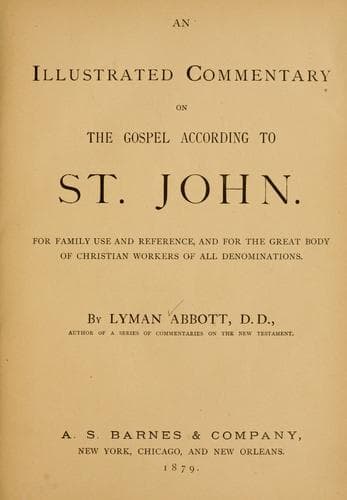
An illustrated commentary on the Gospel according to St. JohnAbbott, Lyman
Religion
An illustrated commentary on the Gospel according to St. John
Abbott, Lyman
Bible. John -- Commentaries
=4. Woman, what have I to do with thee? Mine hour is not yet come.=
Some question has been made respecting the meaning of this language.
It is clear (1) that _woman_ is not a harsh term, and involves no tone
of rebuke or reproof; for when Christ on the cross commends his mother
to John’s care, he uses the same term, “_Woman_, behold thy son” (ch.
19:26); (2) the Greek phrase (τί ἐμοὶ καὶ σοὶ) is properly rendered in
our English version, _What have I to do with thee?_ Though literally
capable of the translation proposed by Dr. Adam Clarke, _What is this
to thee and me?_ that is, _What is this to us?_ the uniform usage of
the N. T. forbids this translation. The Greek is the same in the
following passages, where the translation cannot be other than that
given both there and here. Matt. 8:29, note; Mark 1:24; 5:7; Luke
8:28. I can only understand it as a disclaimer on Christ’s part of any
responsibility in the matter, and an intimation that in his future
mission he was not, as he had heretofore been, subject unto his
mother. There may also be in it implied a gentle rebuke of her
endeavor to elicit from him some display of his miraculous power,
before the time for the commencement of his public ministry.
Chrysostom interprets her spirit here by that of Christ’s brethren
(ch. 7:4), and his reply by his refusal, later, to turn aside from his
work at her solicitation (Matt. 12:47, 48). Evidently she did not
regard his language as that of refusal, for she expects his aid, and
bids the servants do his bidding. “She read a _yes_ latent in his
apparent _no_.”--(_Trench._)--=Mine hour is not yet come.= Not mine
hour to die, though that is usually the signification of this
oft-repeated phrase in John’s Gospel (ch. 7:30; 8:20; 12:23, 27;
13:1); but that would be here meaningless; nor, The hour to work this
miracle, because the wine is not yet wholly exhausted, or the guests
are not conscious of the lack, and have not asked for supply; but, The
hour for me to begin my public ministry, accompanied as it is to be
with the working of miracles, the hour for my manifestation. The
Protestant commentaries see in the language here a rebuke of the
spirit of Mariolatry, in this following the fathers; _e. g._,
Chrysostom: “The answer was not that of one rejecting his mother, but
of One who would show her that having borne him would have availed
nothing, had she not been very good and faithful;” and Augustine: “As
God he has no mother. And now that he was about to perform a divine
work, he ignores, as it were, the human womb, and asks, ‘Woman, what
have I to do with thee?’ as much as to say, Thou art not the mother of
that in me which works miracles; thou art not the mother of my
Godhead.”
5 His mother saith unto the servants, Whatsoever[69] he
saith unto you, do _it_.
[69] Luke 5:5, 6.
Public-domain text, read in full here on John Shaqi.
Reviews
Reviews
No reviews yet
Be the first to share your thoughts on this work.
Elsewhere in the archive
Join the Discussion
Join the discussion
Sign in to leave a comment or review.
Sign InorCreate an account