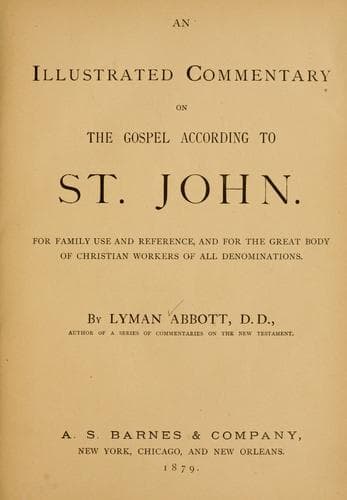
An illustrated commentary on the Gospel according to St. JohnAbbott, Lyman
Religion
An illustrated commentary on the Gospel according to St. John
Abbott, Lyman
Bible. John -- Commentaries
=The Apostle John.= The Apostle John was probably a native, certainly a
resident, of Galilee. His mother, Salome,[2] early became a follower of
Jesus. She was probably one of the women of Galilee who accompanied him
on his missionary tours, and ministered to him of their substance.[3]
She was with him on his last journey to Jerusalem, and during the
passion week, and was one of those women who were last at the cross
and first at the sepulchre.[4] Like the other followers of Jesus, she
anticipated the establishment of a temporal kingdom, was ambitious for
her sons James and John, and made an application for special favors
for them when the kingdom should be established. From a comparison of
Matt. 27:56 with John 19:25, it would appear that she was own sister
to the Virgin Mary, in which case John was own cousin to Jesus. This
opinion is not accepted by all critics, but I believe it to be the
correct one. See note on John 19:25. John’s father, Zebedee, was a
well-to-do fisherman on the shores of the sea of Galilee. Of him we
know very little. He was sufficiently prosperous to own several boats
and to hire men to work for him. Tradition makes him of noble birth;
and this tradition is perhaps confirmed by the fact that John had some
acquaintance with the high-priest.
John has been characterized by those critics who wish to make out that
his character is inconsistent with the idea of his authorship of the
Fourth Gospel, as ignorant and unlettered, on the authority of Acts
4:13, and as a vehement and bigoted Jew on the authority of Galatians,
chap. II, and of the peculiar Hebraic tone of the Book of Revelation.
Both characterizations are quite gratuitous assumptions. In connection
with every Jewish synagogue was a parochial school, in which the
pupils were taught reading, writing, and the rudiments of such natural
sciences as were then in existence. The Jewish children of the common
people were far better educated than those of Greece or Rome. There is
every reason to believe that John received this common education of the
age and community in which he lived, and there is absolutely no reason
whatever to suppose the contrary. It was only by the Pharisees that
John was considered as ignorant and unlettered, and they affixed the
same stigma upon Jesus himself.[5] To the Pharisees the only learning
worth the name was learning in the traditional lore of the church. Of
this the Galilean fisherman was ignorant. In the eyes of a Pharisee
of Jerusalem, Plato himself would have been ignorant and unlearned.
As little reason is there to believe that John was a vehement and
bigoted Jew. There is not the slightest evidence that John was among
the Judaizing Christians to whom Paul so frequently refers, and whom
throughout his life he combated. With one exception, Judas Iscariot,
all the twelve were taken from Galilee. This province of Palestine
was innocent of that formalism and narrowness which characterized the
southern province of Judea.
Public-domain text, read in full here on John Shaqi.
Reviews
Reviews
No reviews yet
Be the first to share your thoughts on this work.
Join the Discussion
Join the discussion
Sign in to leave a comment or review.
Sign InorCreate an account