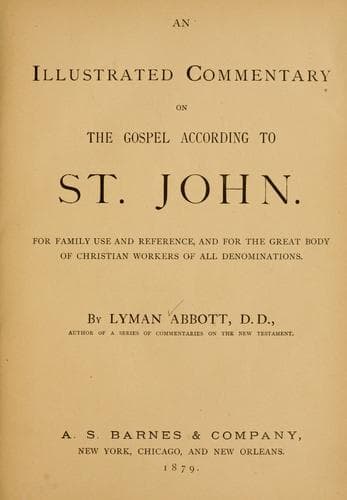
An illustrated commentary on the Gospel according to St. JohnAbbott, Lyman
Religion
An illustrated commentary on the Gospel according to St. John
Abbott, Lyman
Bible. John -- Commentaries
The people had lived in amicable relations
with their heathen neighbors, and had intermarried with them ever
since the days of the treaty of amity between Solomon and the King of
Tyre.[6] The line of commerce between Damascus and the Mediterranean
lay directly across this province. Mineral springs of real or fancied
value near the southern coast of the Sea of Gennesaret made it the
summer resort of the wealthy Romans of the entire land. Thus history
and location, commerce and social relations, combined to make the
inhabitants of Galilee indifferent to the rigid formalism of the
Judeans, and comparatively free from their narrow race and religious
prejudices. Indeed, the two assertions that John was ignorant and
unlearned, and at the same time a narrow and bigoted Jew, contradict
each other. Jewish bigotry and reverence for the traditional lore of
the Jewish church always went together.
The important facts in the history of John, so far as known, are few
and soon told. John the Baptist was second cousin of Jesus, and John
the Apostle was probably, as we have seen, his own cousin. The two
Johns were, therefore, probably acquainted. At all events, when the
Baptist began preaching the gospel of repentance for the remission of
sins, the Apostle was among his disciples; and when the Baptist pointed
out Jesus as the one whom God had indicated to him as the promised
Messiah, John was among the first to leave the old teacher to follow
the new one. This was, however, a temporary following only. We next
meet him fishing with his father at the Sea of Galilee, where Jesus
finds him and his brother, and calls them to become permanent followers
of him. This summons, without hesitation or delay, they obey. From this
time onward John is the constant companion of Jesus. With Peter and
James he belongs to an inner circle of friends: the three are selected
to be the sole witnesses of the resurrection of Jairus’s daughter;
they alone go up into the Mount of Transfiguration, and witness his
glory there; they alone accompany him to the Garden of Gethsemane, and
are invited to be the sharers of his sorrow there; when the arrest
takes place, and all the disciples forsake their Master and flee, John
and Peter turn back and follow him to the scene of his trial, and the
former, with a courage for which few critics give him credit, goes
without concealment, as a disciple, openly, into the house of Caiaphas,
follows the Master to the trial before Pilate, and when the sentence
of crucifixion is pronounced, accompanies the procession to the place
of execution, to remain by the cross till all is over. When the news
of the resurrection is brought to the disciples, he and Peter are the
first to reach the sepulchre. In the subsequent history of the Church,
as recorded in the book of Acts, he does not take a prominent part. To
him was committed the care of Mary, the mother of Jesus, and probably
this sacred charge prevented him from quitting Palestine while she
lived.[7]
Public-domain text, read in full here on John Shaqi.
Reviews
Reviews
No reviews yet
Be the first to share your thoughts on this work.
Join the Discussion
Join the discussion
Sign in to leave a comment or review.
Sign InorCreate an account