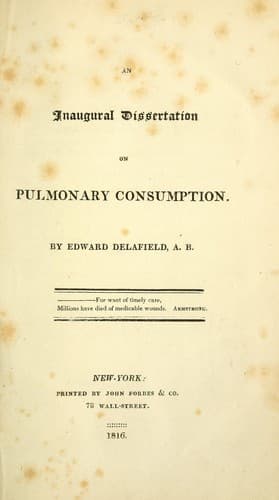
An inaugural dissertation on pulmonary consumption — John Shaqi
An inaugural dissertation on pulmonary consumptionDelafield, Edward
History
An inaugural dissertation on pulmonary consumption
Delafield, Edward
Tuberculosis
As the disease advances, the symptoms of fever become more marked. The
tongue is dry, attended with thirst, loss of appetite, nausea, and
occasional vomiting, and a desire for acids. The secretions generally
are checked. Perspiration is diminished, and the skin is hot and dry.
The urine is at first diminished in quantity, and high coloured. The
menses, in females, are either suppressed or very irregular. The
bowels are frequently costive. The patient passes restless nights,
and is prevented sleeping by a tormenting cough, or if he sleeps, is
troubled with dreams. In consequence of indigestion, pain is felt in
the situation of the stomach, attended with flatulence. The patient
begins to have a pallid countenance, and emaciation gradually takes
place.
These symptoms may continue a length of time, gradually debilitating
the patient. But the expectoration which at first was frothy, in
small quantity, and coughed up with difficulty and pain, increases,
and gradually passing through all the stages between mucus and pus,
at length becomes decidedly purulent. A new train of symptoms follow.
Hectic fever makes its appearance, commencing with irregular cold and
shivering fits, returning frequently during the day. It soon, however,
assumes a decided character, and has two marked exacerbations, the
one at noon, the other at night. These exacerbations begin with a
sense of coldness, succeeded by heat, and at night terminating in
profuse perspiration. During the chill and hot fit, the cough, pain,
and dyspnœa are aggravated, but relieved by the sweating. The pulse
before the paroxysm is accelerated and weak, during its continuance
quick and strong, but abates as the perspiration flows. The countenance
is generally pale, but during the exacerbation is marked by a
circumscribed crimson flush, which occurs mostly at noon, but may be
produced by taking food or any other cause of excitement. The profuse
sweats do not occur after the exacerbation at noon, but in the morning,
while the patient is warm in bed, with the system relaxed by sleep.
The perspiration is principally confined to the superior parts of the
body, as the neck, breast, and about the shoulders. The tongue is often
very clean during hectic fever, but sometimes furred. The bowels are
generally torpid, alternating with diarrhœa.
Public-domain text, read in full here on John Shaqi.
Reviews
Reviews
No reviews yet
Be the first to share your thoughts on this work.
Join the Discussion
Join the discussion
Sign in to leave a comment or review.
Sign InorCreate an account