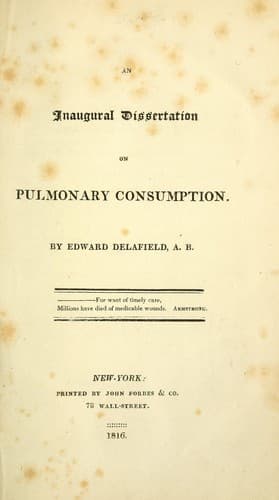
An inaugural dissertation on pulmonary consumptionDelafield, Edward
History
An inaugural dissertation on pulmonary consumption
Delafield, Edward
Tuberculosis
From the detail of symptoms which has just been given, it is evident,
that there are two distinct stages of Phthisis Pulmonalis, each
characterised by peculiar symptoms, and requiring peculiar treatment.
The first, incipient, or acute stage as it is variously termed
by authors, is the stage of inflammation, and terminates as soon
as purulent expectoration and hectic fever commence. The second,
confirmed, or chronic stage commences where the first terminates, and
ends most generally in death. We would not however assert, that these
stages can always be accurately distinguished, and a line drawn between
them. On the contrary, hectic fever may occur early in the disease,
before any expectoration of pus takes place, and inflammatory symptoms
frequently attend its advanced stage. In general, the distinction can
be made, and must necessarily guide the prudent physician.
Having taken a view of the causes and symptoms of Phthisis Pulmonalis,
we are now prepared to investigate the proximate cause of the disease.
From the nature and extent of these symptoms, it appears evidently a
disease of the whole system, and not confined merely to the lungs.
The proximate cause, as taught by Dr. Hosack, in his lectures, is, an
inflammation of the lungs, terminating either in a purulent secretion,
or ulceration in their substance. This opinion is much strengthened by
the analogy before remarked between Phthisis Pulmonalis and Pneumonia.
It is a little singular that Dr. Rush, notwithstanding he had remarked
this close analogy, and although he speaks of inflammatory fever as a
part of the disease, and prescribes blood-letting in its treatment,
should yet have made debility its proximate cause. This is only one
instance among many, of physicians arriving at precisely the same
modes of treatment by directly opposite routes. If that theory of
inflammation be admitted, which makes debility its cause, so far it
is also the proximate cause of Phthisis Pulmonalis. In the secondary
species of Phthisis, hereafter to be considered, debility may be fairly
ranked as the proximate cause, and the indications of cure correctly
drawn from it. But in the primary disease under consideration, if we
were to found our indications on this basis, and thence deduce the
propriety of exhibiting powerful tonics in the first stage of the
disease, when brought to the test of practice, its error would soon
become sufficiently glaring.
Various other causes have been successively treated of by authors,
but to shew their inconsistency and absurdity, it is only necessary
to observe that, “the existence of an acid or an alkali, of chemical
acrimony, or mechanical changes in the blood, of corroding volatile
particles, and even of animalcula in the lungs, have been vaguely
conjectured to be the cause of pulmonary ulcer and hectic fever.[7]”
Public-domain text, read in full here on John Shaqi.
Reviews
Reviews
No reviews yet
Be the first to share your thoughts on this work.
Join the Discussion
Join the discussion
Sign in to leave a comment or review.
Sign InorCreate an account