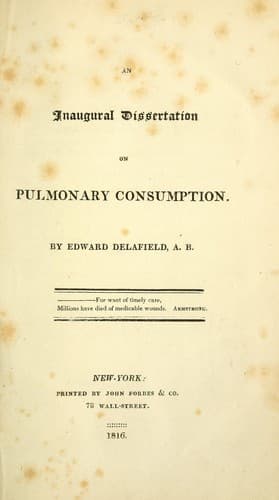
An inaugural dissertation on pulmonary consumptionDelafield, Edward
History
An inaugural dissertation on pulmonary consumption
Delafield, Edward
Tuberculosis
Assuming then, inflammation of the lungs, and consequent ulceration
of their substance as the proximate cause of Phthisis Pulmonalis, we
naturally deduce the following indications in the treatment of the
disease.
1. To endeavour to relieve the inflammation of the lungs, and promote
its resolution.
2. If, notwithstanding all our efforts, suppuration takes place, to
give sufficient support and tone to the system to enable the ulcers to
heal.
In fulfilling these indications, our first object is to remove the
remote causes, where it is possible. If the patient’s occupation is
one of those which predisposes to Consumption, unless it be abandoned,
or at least so modified as to correct the objectionable parts of it,
we cannot hope to cure the disease. If the disease arise from the
suppression of an accustomed evacuation, our utmost endeavours must
be made to restore it. Should suppression of the menses be the cause,
means calculated to produce their return must be resorted to. If an
ulcer or fistula has healed up, they must be re-opened, or issues
established in more convenient situations. In short, the rule is plain
and simple. Remove the remote causes, wherever it is practicable.
Among the remedies which are necessary to fulfil the first indication,
the most prominent is Blood-letting. This remedy has been strongly
advocated by many of the most distinguished authors who have written
on Consumption; and its propriety admitted by all under certain
circumstances. Probably, most of the injurious effects attributed
to it, may be accounted for by a proper distinction not having
been made between Primary and Secondary Phthisis Pulmonalis. When
bleeding has been practised in the secondary form of the disease,
it has been generally injurious, and hence an odium has been cast
upon its employment in any circumstances. In the same manner, it
has done mischief, when used too late in Primary Phthisis, and thus
another groundless argument furnished against the remedy. But the
indiscriminate use of blood-letting is not here contended for. Its
judicious and cautious use, when inflammatory action is evident, alone
is intended to be advocated. On the other hand, too timid practice
may induce us to withhold the lancet when it is necessary; and we
may thus do as much injury by losing the proper time for action, as
we would have done by pushing the remedy too far. It is difficult to
fix the period beyond which it is improper to bleed in Consumption.
Dr. Hosack insists that as long as there is any pain or soreness on
taking a full inspiration, the lancet is necessary. This rule is not
applicable to practice; for if we adopt it, we may bleed the patient
until he dies. Until that moment will the pain in some instances
continue. It is not unfrequent, after the patient has been exhausted
by colliquative sweats, and profuse diarrhœa, for pain in the breast
to recur at intervals, a few days before death: and what practitioner,
Public-domain text, read in full here on John Shaqi.
Reviews
Reviews
No reviews yet
Be the first to share your thoughts on this work.
Join the Discussion
Join the discussion
Sign in to leave a comment or review.
Sign InorCreate an account