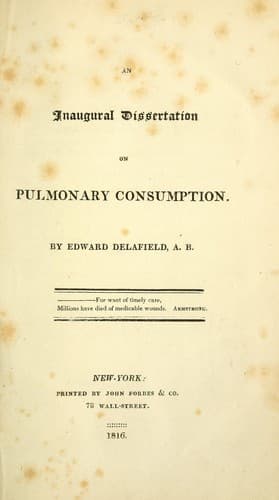
An inaugural dissertation on pulmonary consumptionDelafield, Edward
History
An inaugural dissertation on pulmonary consumption
Delafield, Edward
Tuberculosis
The stimulating balsams and gums are also proper in this stage. They
have been highly recommended by Morton; and myrrh in particular is
prescribed with great confidence by Simmons. They are objected to by
Fothergill, on the ground, that by their stimulating properties, they
increase the inflammation of the lungs. His objection appears well
founded, while symptoms of acute inflammation still exist; but after
they have subsided, the cough and other distressing symptoms of the
last stage of Phthisis, may be much alleviated by these medicines. By
their stimulating effects upon the whole system, also, they may be
useful at a time when the patient is sinking under great debility.
As stimulating applications are frequently found necessary and useful
to indolent ulcers on the surface of the body, it naturally occurred
that similar applications might be made with advantage to ulcers of
the lungs. With this view, the steam of tar water, and the vapour of
sulphuric æther inhaled in respiration, have been used in the treatment
of Consumption.[9] With the same restrictions as are necessary with
the stimulating gums and balsams, these remedies may be beneficial. It
is not probable, however, that any permanent relief can be derived from
them; they can only mitigate symptoms.
To check the profuse sweats, which occur at this period, and add
materially to the debility of the patient, the elixir of vitriol is an
useful medicine. As a general tonic it acts beneficially also upon the
whole system.
With the view of quietting the cough and procuring rest at night,
opiates are necessary; and fortunate are we that we have in our
possession, a remedy, which although it will not permanently cure the
disease, palliates the symptoms, at least for a time; and makes more
smooth the path to death. It is true that opium produces some ill
effects. It debilitates the stomach, and injures the appetite; but when
the symptoms are urgent, it cannot for these reasons be dispensed with.
By lulling pain, and giving rest to the watchful patient, it more than
counterbalances these disadvantages. The humulus lupulus or common
hops, does not possess the objectionable properties of opium, but with
its anodyne combines some tonic powers, and promises to be an excellent
substitute for that medicine.
The large and frequent use of syrups in the form of expectorant
mixtures and linctuses, to alleviate cough, is very injurious. They
cloy the appetite, destroy the tone of the stomach, and prevent the
taking of nutritious aliment, which is now so necessary; and frequently
without producing any material relief of the symptom for which they are
prescribed.
The use of opiates is necessary also, to check the profuse diarrhœas,
which now alternate with costiveness, and reduce the already
debilitated patient. With the same view, the chalk mixture may be used
with advantage, and the astringent medicines, Kino and Catechu, with
others of the same class.
Public-domain text, read in full here on John Shaqi.
Reviews
Reviews
No reviews yet
Be the first to share your thoughts on this work.
Join the Discussion
Join the discussion
Sign in to leave a comment or review.
Sign InorCreate an account