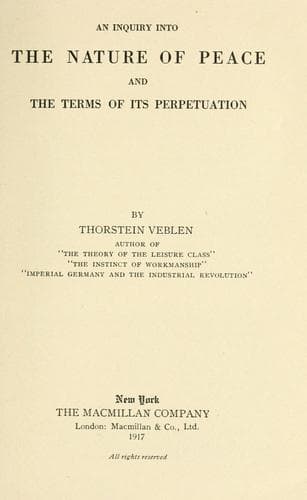
An Inquiry into the Nature of Peace and the Terms of Its PerpetuationVeblen, Thorstein
Philosophy
An Inquiry into the Nature of Peace and the Terms of Its Perpetuation
Veblen, Thorstein
Peace; World War, 1914-1918 -- Peace
Under this current regime of law and order, according to the equitable
principles of Natural Rights, the man without means has no pecuniary
rights which his well-to-do pecuniary master is bound to respect. This
may have been an unintended, as it doubtless was an unforeseen, outcome
of the move out of feudalism and prescriptive rights and immunities,
into the system of individual liberty and manhood franchise; but as
commonly happens in case of any substantial change in the scheme of
institutional arrangements, unforeseen consequences come in along with
those that have been intended. In that period of history when Western
Europe was gathering that experience out of which the current habitual
scheme of law and order has come, the right of property and free
contract was a complement and safeguard to that individual initiative
and masterless equality of men for which the spokesmen of the new era
contended. That it is no longer so at every turn, or even in the main,
in later time, is in great part due to changes of the pecuniary order,
that have come on since then, and that seem not to have cast their
shadow before.
In all good faith, and with none but inconsequential reservations, the
material fortunes of modern civilised men--together with much else--have
so been placed on a pecuniary footing, with little to safeguard them at
any point except the inalienable right of pecuniary self-direction and
initiative, in an environment where virtually all the indispensable
means of pecuniary self-direction and initiative are in the hands of
that contracted category of owners spoken of above. A numerical
minority--under ten percent of the population--constitutes a conclusive
pecuniary majority--over ninety percent of the means--under a system of
law and order that turns on the inalienable right of owners to dispose
of the means in hand as may suit their convenience and profit,--always
barring recourse to illegal force or fraud. There is, however, a very
appreciable margin of legal recourse to force and of legally protected
fraud available in case of need. Of course the expedients here referred
to as legally available force and fraud in the defense of pecuniary
rights and the pursuit of pecuniary gain are not force and fraud _de
jure_ but only _de facto_. They are further, and well known,
illustrations of how the ulterior consequences of given institutional
arrangements and given conventionalised principles (habits of thought)
of conduct may in time come to run at cross purposes with the initial
purpose that led to the acceptance of these institutions and to the
confirmation and standardisation of these habitual norms of conduct. For
the time being, however, they are "fundamentally and eternally right and
good."
Public-domain text, read in full here on John Shaqi.
Reviews
Reviews
No reviews yet
Be the first to share your thoughts on this work.
Elsewhere in the archive
Join the Discussion
Join the discussion
Sign in to leave a comment or review.
Sign InorCreate an account