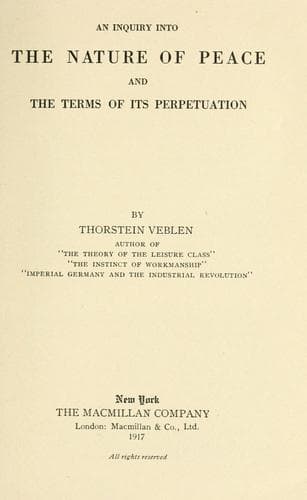
An Inquiry into the Nature of Peace and the Terms of Its PerpetuationVeblen, Thorstein
Philosophy
An Inquiry into the Nature of Peace and the Terms of Its Perpetuation
Veblen, Thorstein
Peace; World War, 1914-1918 -- Peace
Certain general assertions may be made with some confidence. The
experiences of the war, particularly among the immediate participants
and among their immediate domestic connections--a large and increasing
proportion of the people at large--are plainly impressing on them the
uselessness and hardship of such a war. There can be no question but
they are reaching a conviction that a war of this modern kind and scale
is a thing to be avoided if possible. They are, no doubt, willing to go
to very considerable lengths to make a repetition of it impossible, and
they may reasonably be expected to go farther along that line before
peace returns. But the lengths to which they are ready to go may be in
the way of concessions, or in the way of contest and compulsion. There
need be no doubt but a profound and vindictive resentment runs through
the British community, and there is no reason to apprehend that this
will be dissipated in the course of further hostilities; although it
should fairly be expected to lose something of its earlier exuberant
malevolence and indiscrimination, more particularly if hostilities
continue for some time. It is not too much to expect, that this popular
temper of resentment will demand something very tangible in the way of
summary vengeance on those who have brought the hardships of war upon
the nation.
The manner of retribution which would meet the popular demand for
"justice" to be done on the enemy is likely to be affected by the
fortunes of war, as also the incidence of it. Should the governmental
establishment and the discretion still vest in the gentlemanly classes
at the close of hostilities, the retribution is likely to take the
accustomed gentlemanly shape of pecuniary burdens imposed on the people
of the defeated country, together with diplomatically specified
surrender of territorial and colonial possessions, and the like; such as
to leave the _de facto_ enemy courteously on one side, and to yield
something in the way of pecuniary benefit to the gentlemen-investors in
charge, and something more in the way of new emoluments of office to the
office-holding class included in the same order of gentlemen. The
retribution in the case would manifestly fall on the underlying
population in the defeated country, without seriously touching the
responsible parties, and would leave the defeated nation with a new
grievance to nourish its patriotic animosity and with a new incentive
to a policy of watchful waiting for a chance of retaliation.
Public-domain text, read in full here on John Shaqi.
Reviews
Reviews
No reviews yet
Be the first to share your thoughts on this work.
Elsewhere in the archive
Join the Discussion
Join the discussion
Sign in to leave a comment or review.
Sign InorCreate an account