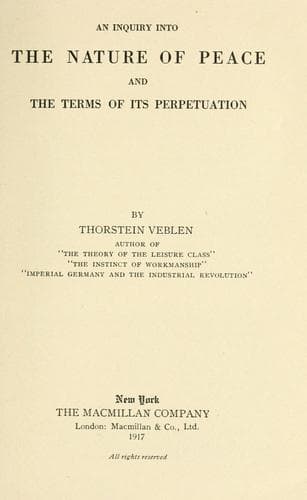
An Inquiry into the Nature of Peace and the Terms of Its PerpetuationVeblen, Thorstein
Philosophy
An Inquiry into the Nature of Peace and the Terms of Its Perpetuation
Veblen, Thorstein
Peace; World War, 1914-1918 -- Peace
But it is to be noted that under the stress of the war there is going
forward in the British community a progressive displacement of
gentlemanly standards and official procedure by standards and procedure
of a visibly underbred character, a weakening of the hold of the
gentlemanly classes on the control of affairs and a weakening of the
hold which the sacred rights of property, investment and privilege have
long had over the imagination of the British people. Should hostilities
continue, and should the exigencies of the war situation continue to
keep the futility of these sacred rights, as well as the fatuity of
their possessors, in the public eye, after the same fashion as hitherto,
it would not be altogether unreasonable to expect that the discretion
would pass into the hands of the underbred, or into the hands of men
immediately and urgently accountable to the underbred. In such a case,
and with a constantly growing popular realisation that the directorate
and responsible enemy in the war is the Imperial dynasty and its
pedigreed aids and abettors, it is conceivable that the popular
resentment would converge so effectually on these responsible
instigators and directors of misfortune as to bring the incidence of the
required retribution effectually to bear on them. The outcome might, not
inconceivably, be the virtual erasure of the Imperial dynasty, together
with the pedigreed-class rule on which it rests and the apparatus of
irresponsible coercion through which it works, in the Fatherland and in
its subsidiaries and dependencies.
With a sufficiently urgent realisation of their need of peace and
security, and with a realisation also that the way to avoid war is to
avoid the ways and means of international jealousy and of the national
discriminations out of which international jealousy grows, it is
conceivable that a government which should reflect the British temper
and the British hopes might go so far in insisting on a neutralisation
of the peoples of the Fatherland as would leave them without the
dynastic apparatus with which warlike enterprise is set afoot, and so
leave them also perforce in a pacific frame of mind. In time, in the
absence of their dearly beloved leavings of feudalism, an enforced
reliance on their own discretion and initiative, and an enforced respite
from the rant and prance of warlike swagger, would reasonably be
expected to grow into a popular habit. The German people are by no means
less capable of tolerance and neighbourly decorum than their British or
Scandinavian neighbours of the same blood,--if they can only be left to
their own devices, untroubled by the maggoty conceit of national
domination.
Public-domain text, read in full here on John Shaqi.
Reviews
Reviews
No reviews yet
Be the first to share your thoughts on this work.
Elsewhere in the archive
Join the Discussion
Join the discussion
Sign in to leave a comment or review.
Sign InorCreate an account