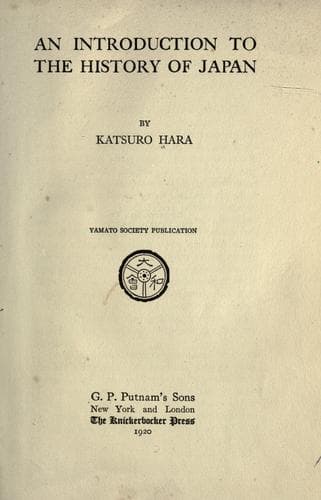
An Introduction to the History of JapanHara, Katsuro
History
An Introduction to the History of Japan
Hara, Katsuro
Japan -- History
go over to the second point.
To consider Japanese history as a miniature of the world's history is
rather a new assertion, so that it requires conclusive justification. It
is now generally believed or assumed that every nation continues to
evolve as an individual does, till it reaches its climax of growth and
begins to decay. Hence many modern historians have successively tried to
extract certain principles by the process of induction from kindred
historical events which took place in different countries and ages, and
thus to raise the study of history to the rank of a science in the same
sense as that in which the word is used when we speak of natural
phenomena. It is a great pity, however, that every historical event is
of a very ephemeral nature, never to be repeated in exactly the same
form in which it once occurred. And if it passes away, it passes away
forever, not to be retarded in the midst of its course by the will of an
investigator. Often one can contribute with full consciousness to the
happening of an event, or can alter the course of it, but one cannot
undo by any means the event itself and wash the ground as if nothing had
taken place. Moreover, historical facts are very difficult to detach
from their environment entirely, however isolated they seem to be, and
on that account they are not fit to be made objects of laboratory
experiments. In a school classroom the pupils are taught to solve an
algebraic equation of a binomial expression by supposing the value of x
and y alternately to be equal to zero. How much the task of historians
would be lightened, if we could for some time trace the effect of a
certain cause exclusively, setting at naught other concurrent causes, as
if those causes might be supposed to be standing still for a moment of
observation or hypothetically cancelled for a necessary time!
Strictly speaking, the above device is out of the question in the case
of any historical investigation. Setting that aside, there is still
another greater difficulty to encounter in the study of history. Every
school-boy knows that there is a fundamental law in physics, that when a
body is set in motion by a certain impetus, it will move on continuously
in one direction with the same momentum, so long as it is left
uninfluenced by any other new force. It is true, however, that such a
case exists very rarely even in natural phenomena, and it would be quite
absurd to look for the like in the domain of history. More than one
cause acts conjointly upon individuals, families, tribes, or nations,
and before those causes cease to influence, other new causes generally
come into play, so that the influences of the latter are interwoven with
those of the former causes or groups of causes, and make discrimination
between them exceedingly difficult.
Public-domain text, read in full here on John Shaqi.
Reviews
Reviews
No reviews yet
Be the first to share your thoughts on this work.
Join the Discussion
Join the discussion
Sign in to leave a comment or review.
Sign InorCreate an account