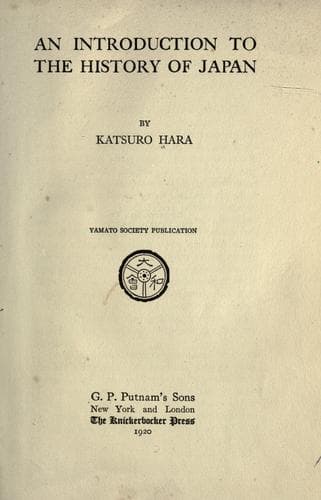
An Introduction to the History of Japan — John Shaqi
An Introduction to the History of JapanHara, Katsuro
History
An Introduction to the History of Japan
Hara, Katsuro
Japan -- History
Summing up the above, one cannot entirely isolate a country from its
surroundings, in order to see what a country or a nation would be able
to achieve, if untouched by any outward influence, that is to say,
solely out of its own immanent evolving forces. Next, it is none the
less difficult to observe scientifically the effects of some outward
forces acting on a nation, by warding off the influx of subsequent
influences and thus giving to the forces in question the full scope and
time to exert their influence. It often happens, however, that what
cannot be done artificially may be found produced spontaneously, and
though we cannot make experiments, in the strict sense of the word,
while observing historical data, it is possible that the history of a
nation or of an age may be taken as a case or a phase of an experiment,
if such an experiment could ever be tried at all. And indeed the history
of Japan may be considered as one of a few such happy cases.
Here I need not talk much about the history of our country anterior to
the introduction of the Chinese civilisation. After the opening of the
regular intercourse between this country and China in the beginning of
the seventh century, institutions, arts, learning, and even the manners
of every day life continued for a long time to be brought thence by many
official emissaries and students, and copied faithfully here, though
generally with slight modifications. At that time, however, there being
no country far advanced in civilisation other than China near us, the
Chinese influence, the only exotic one, was allowed to take sole and
full effect. Besides this, that Chinese civilisation itself was not
encouraged to flow in endlessly. When, with the decay of the T'ang
dynasty and the setting in of the anarchical condition following it in
China, the highly finished culture attained during that dynasty, perhaps
the most perfect one China had ever seen, began to degenerate there, the
official intercourse between that country and Japan was interrupted. Of
course, I do not mean to say that even private and intermittent
commercial intercourse was also suspended at the same time, for the
geographical position of our country toward China does not allow the
former to remain entirely isolated from the latter. The suspension of
the regular intercourse itself, however, was enough to save Japan from
becoming entangled in the vicissitudes of the various dynasties
following the T'ang, and our forefathers were left to themselves to make
the best use of, that is to say, to digest, what had already been
brought in abundantly. In the succeeding period the quiet process of
rumination went on for several centuries. If we look back into the
Japanese history of that time, therefore, we can ascertain fairly
scientifically the effect of a high civilisation acting on a naive
population not yet sufficiently organised as a nation, as our country
was at that period, and likewise we can observe many traits of the old
Public-domain text, read in full here on John Shaqi.
Reviews
Reviews
No reviews yet
Be the first to share your thoughts on this work.
Join the Discussion
Join the discussion
Sign in to leave a comment or review.
Sign InorCreate an account