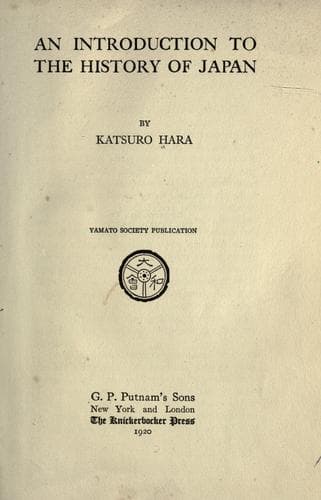
An Introduction to the History of JapanHara, Katsuro
History
An Introduction to the History of Japan
Hara, Katsuro
Japan -- History
occurrence in our country, the export of cereals used to be forbidden in
most of the neighboring territories, even when they had a "bumper crop."
Such an internal embargo testifies that not only had Japan been closed
against foreigners, but within herself each territory cared only for its
own welfare, adhering to a mercantilist principle, as if it stood quite
secluded from the rest of the country. Very little of the cohesion
necessary to an integral state could be perceived in Japan of that time.
Such was the condition of Japan under the Tokugawa Shogunate presented
to the eyes of, and easily noticed by, the foreign observers, who
visited our country at the beginning and the middle of the period. Nay,
many of the foreigners who wrote about our land and people seem to have
shared nearly the same views as above. In truth, however, many important
factors of the Japanese history of this epoch have been omitted by
them, and the idea they could form of Japan from the one-sided and
scanty material at their disposal was only a very incomplete image of
modern Japanese civilisation. I shall, therefore, try to give a general
survey of the political and social condition of our country from the
beginning of the seventeenth century down to the Revolution of the
Meidji, and then shall treat in brief about the civilisation of the age.
The Shogunate of the house of the Tokugawa was not an entirely new
invention. It was a partial recognition of the old regime which Iyeyasu
had inherited from Hideyoshi, as far as the territorial lords were
concerned, who were installed or recognised anterior to the advent of
Iyeyasu to power. Though a great many of the former feudatories,
especially those who had been faithful to the House of the Toyotomi to
the last, had been killed or deprived of their possessions after the
decisive battle of Sekigahara, not a few of them survived, counting
among them the most powerful of the _daimyo_, the House of Mayeta, who
was the master of Kaga and two other provinces on the Sea of Japan. The
lords of this kind had formerly been the equals of the Tokugawa, when
the latter was standing under the protection of Hideyoshi, and it was
difficult for the new Shogunate, in a country where the Emperor has ever
been the paramount sovereign, to make those lords formally swear the
oath of fealty to itself. The nature of the sovereignty, therefore, of
the Tokugawa over the feudatories aforesaid was only that of _primus
inter pares_. The _daimyo_ who stood in this relation to the Shogunate
were called _tozama_.
Public-domain text, read in full here on John Shaqi.
Reviews
Reviews
No reviews yet
Be the first to share your thoughts on this work.
Elsewhere in the archive
Join the Discussion
Join the discussion
Sign in to leave a comment or review.
Sign InorCreate an account