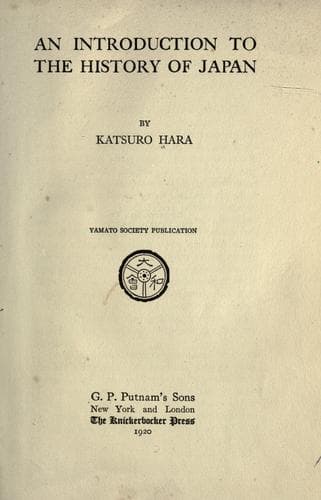
An Introduction to the History of JapanHara, Katsuro
History
An Introduction to the History of Japan
Hara, Katsuro
Japan -- History
The rest of the _daimyo_, together with the bodyguard of the Shogun, the
so-called "eighty thousand" with their habitual residence at Yedo, made
up the hereditary retainers or _fudai_. The non-domestic _daimyo_ had
nothing to do with the Shogun's central government, all the posts of
which, from such high functionaries as the _rochu_ or elders, who were
none other than the cabinet ministers of the Shogunate, down to such
petty officials as scribes and watchmen, had been all filled with
domestics of various grades. As far as these domestics or direct
retainers of the Shogunate were concerned, the military regime of the
Tokugawa can be held to have been a revived form of that of Kamakura. In
the former, however, the disparity in power and wealth between the upper
and the lower domestics of the Shogun was far more remarkable than it
had been among the retainers of the latter, that is to say, the _djito_.
The term "go-kenin," held to be honourable in the time of Kamakura,
became, in the Tokugawa period, a designation of the lowest order of the
direct vassals of the Shogun. A certain number belonging to the upper
class of the _fudai_ or domestics of the Tokugawa Shogunate were made
_daimyo_, and placed on the same footing as feudatories of historical
lineage, the former equals of the Tokugawa, and formed with them
henceforth the highest military nobility of the country. The remainder
of the domestics, who were not raised to the rank of _daimyo_, were
comprised under the name of _hatamoto_, which means "under the
standard," that is to say, the Body-guard of the Shogun. Among the
members of this body there were indeed numerous scales of gradation. The
lowest of them had to lead a very miserable and straitened life in some
obscure corners of the city of Yedo, while the best of them stood as
regards income very near to minor _daimyo_, and were often more
influential. Their political status, however, notwithstanding manifold
differences in rank among them, was all the same, all being equally,
direct vassals of the Shogunate, and having no regular warriors or
_samurai_ as their own vassals. They, therefore, belonged to the lowest
grade of the privileged classes in the military hierarchy, and in this
respect there was no cardinal difference between them and the common
_samurai_ who were vassals of ordinary _daimyo_. That they were,
however, the immediate subjects of the Shogun, and that they did not owe
fealty to any _daimyo_, who was in reality subordinate at least to the
Shogun, if not his vassal in name, placed them in a status like that of
the knights immediate of the Holy Roman Empire or of the mediatised
princes of recent Germany; in short, above the status of ordinary
_samurai_ attached to an ordinary _daimyo_. Strictly speaking, between
these two there interposed another group of _samurai_. They were the
vassals of the three _daimyo_ of extraordinary distinction, of Nagoya in
the province of Owari, of Wakayama in the province of Kii, and of Mito
Public-domain text, read in full here on John Shaqi.
Reviews
Reviews
No reviews yet
Be the first to share your thoughts on this work.
Elsewhere in the archive
Join the Discussion
Join the discussion
Sign in to leave a comment or review.
Sign InorCreate an account