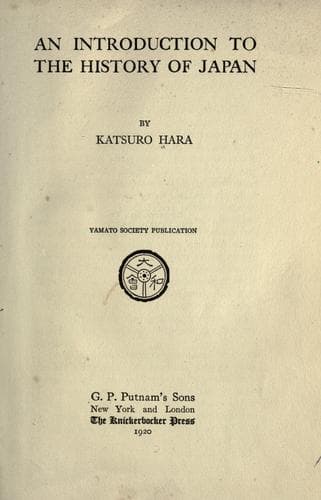
An Introduction to the History of JapanHara, Katsuro
History
An Introduction to the History of Japan
Hara, Katsuro
Japan -- History
in the province of Hitachi. All these three being of the lateral
branches of the Tokugawa, were held in specially high regard, and put at
the topmost of all the other _daimyo_, so that their vassals considered
themselves to be quasi-_hatamoto_ and therefore above the "common" or
"garden" _samurai_.
The _daimyo_ acted as virtual potentates in territories granted to them,
and held a court and a government there, both modelled largely after the
household and the government of the Shogun at Yedo. The better part of
the _daimyo_ resided in castles built imposingly after the architectural
style of the fortresses in Europe at that time, the technic having
perhaps been introduced along with Christianity, and they led a life far
more easy and elegant, though more regular, than the _shugo_ of the
Ashikaga age. It has been ascribed, by the way, to the rare sagacity of
Iyeyasu as a politician, that the territories of the two kinds of
_daimyo_, _tozama_ and _fudai_, were so adroitly juxtaposed, that the
latter were able to keep watch over the former's attitude toward the
Shogunate.
The _daimyo_ were ranked according to the officially estimated amount of
rice to be produced in the territory of each. In the time of Kamakura,
the renumeration of the _djito_ was counted by the area of ricefields in
the manor entrusted to his care. By and by, the land which was the
source of the renumeration for a _djito_ came to be partitioned among
his numerous descendants, and some of the portions allotted became so
small, that it was but ridiculous to think of exercising the
jurisdiction of military police over them. Area of land began to cease
thus to be the standard of valuation of the income of a _djito_, when
the office of _djito_ meant only the emolument accompanying it, and no
longer carried with it the responsibility incumbent on it at its first
establishment. The ultimate result of such a change was that the
quantity or the price of rice produced began to be adopted gradually as
the standard of valuation of the income of territorial lords, and for a
while the two standards were in use together till the end of the
Ashikaga age. Moreover, infrequently part of the income of a _shugo_ was
reckoned by the quantity of rice, while another part of the income of
the same _shugo_ was assessed by the sale-price of the rice cultivated.
This promiscuous way of valuation, however, caused great irregularity
and confusion. For, added to the disagreement about the real quantity of
rice produced and the amount registered to be produced, the price of the
cereal itself had been so ceaselessly fluctuating according to the
inconstant condition of crops, that there was no such thing as a regular
standard price of rice invariably applicable to any year and to any
locality. Nevertheless, in an age when no uniform system of currency was
established and to accept any coin at its face value was an impossible
matter, in other words, when it was difficult to represent the price of
Public-domain text, read in full here on John Shaqi.
Reviews
Reviews
No reviews yet
Be the first to share your thoughts on this work.
Elsewhere in the archive
Join the Discussion
Join the discussion
Sign in to leave a comment or review.
Sign InorCreate an account