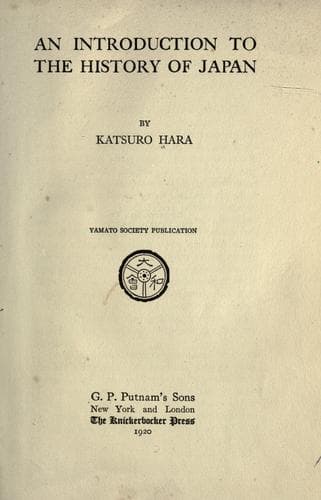
An Introduction to the History of JapanHara, Katsuro
History
An Introduction to the History of Japan
Hara, Katsuro
Japan -- History
arresting culprits, and therefore good only for lower _samurai_ or those
below them in rank, who were generally in charge of the police business
in all territories.
With such military accomplishments, the _samurai_ of the period were to
serve their territorial master in time of war as leaders and fighters,
for it was still the age in which all warriors were expected to display
a personal bravery, parallel to their ability to lead and command
troops, as in medieval Europe. As there had been neither external nor
civil war, however, for more than two centuries since the semi-religious
insurrection at Shimabara in Kyushu was subdued in the year 1638, war
was prepared for only as an imaginary possibility, and not as a probable
emergency. The _samurai_ of all territories, therefore, though said to
be on a constant war footing, were not trained as they should have
been. We see indeed the division of them into fighting groups and the
appointment of a leader for each group in times of peace. But there was
no manoeuvring nor any training of a like kind in tactical movements.
The only military exercise approaching it was the hunting of wild game
or the sham hunting which ended in cruelly sacrificing dogs, and even
these sports were not practised frequently. That those pieces of
Japanese armour, which foreigners can now see in many museums in Europe
and America, had been long found to be a sort of thing rather
inconvenient to wear in this country, yet had nevertheless continued to
be a furniture indispensable to every household of _samurai_ and to be
embellished with an exquisite workmanship, proves how academically war
had been regarded in those far-off days. It can be easily gathered from
the above statement that the _samurai_ of the time were more civil
functionaries than fighting men. Their real status, however, being
warriors and not civilians, they were constantly subjected to martial
law. They had to serve their master always with all their might, holding
themselves responsible with their lives, as if they were on the
battlefield facing the enemy. Many examples may be cited from the
history of the age of _samurai_ suicides, committed on account of some
misdemeanour or the mismanagement of the civil administration confided
to him. In effect, an armed peace reigned throughout the Empire.
CHAPTER XII
TOKUGAWA SHOGUNATE, CULTURE AND SOCIETY
In the previous chapter I have dwelt on the military and political
organisation of the time of the Tokugawa Shogunate somewhat more fully
than was appropriate for a book of such small compass as this. What was
then the civilisation, which had been supported and sheltered by this
organisation and regime? That must be told subsequently.
Public-domain text, read in full here on John Shaqi.
Reviews
Reviews
No reviews yet
Be the first to share your thoughts on this work.
Elsewhere in the archive
Join the Discussion
Join the discussion
Sign in to leave a comment or review.
Sign InorCreate an account