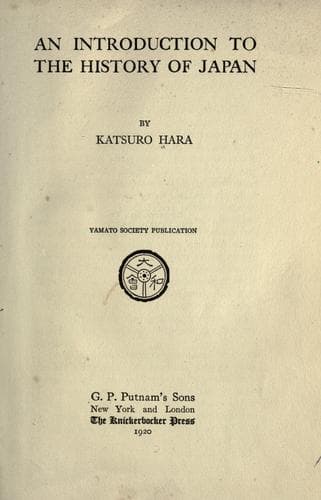
An Introduction to the History of JapanHara, Katsuro
History
An Introduction to the History of Japan
Hara, Katsuro
Japan -- History
As the well-planned military regime of the Shogunate can be said to have
been based on the assumption that war was a far-distant possibility, an
imaginary danger, and as at the same time the Shogunate had watched
jealously not to stir up _daimyo_ and _samurai_ to so warlike a pitch of
self-confidence that they would believe themselves able to cope with the
Shogun, there had lain the chief difficulty of sustaining the martial
spirit of the nation in full strength, that is to say, of continuing the
military regime as it had been at first. There were of course several
gradations in the intensity of the fighting spirit of the people in
different localities of the country. In both extremities of the Empire,
in the south of Kyushu and in the north of Honto, where civilisation
was rather at a low ebb, the martial spirit had continued not much
abated since the time of the Ashikaga. On both sides of the boundary of
two such adjoining territories, a difference of dialect was clearly
perceivable, and an acute hostile feeling against each other prevailed.
People were not allowed to marry their neighbors beyond the frontier,
and this rule was strictly applied to all members of the warrior-class.
In brief, they were always staring each other in the face, as if ready
to fight at any time. As to the greater part of the Empire, however,
including the territories situated between the two extremities, that is
to say, in those regions of the country where the people were more
enlightened, no such animosity between the peoples of neighboring
_daimyo_ was to be noticed. There marriages had been contracted freely
between the subjects of different lords, a relationship which could only
arise from the assumption that most probably there would occur no war
between the two _daimyo_, and there would be no fear of such marriages
becoming an awkward connection. Adjoining territories maintaining such
intimate relations, being connected by the personalities of the
inhabitants, should be considered not as quasi-independent states ranged
side by side and in dangerous rivalry, verging almost on belligerency,
but as neighboring governmental departments in the same well-centralised
state. It may be gathered from these data that the more enlightened and
by far the greater part of the Japanese nation were so peace-loving,
that they organised all their ways of living on the assumption of a
permanent peace. And that absolute peace had verily continued for more
than two centuries in a country said to have been dominated by an
absolute military regime, more than testifies how averse is the Japanese
nation from wanton warfare. Foreigners should ponder this irrefutable
fact in the history of Japan, a fact which can not elsewhere be found in
abundance even in the history of European and American states, before
they calumniate our nation as the most bellicose and dangerous in the
world.
Public-domain text, read in full here on John Shaqi.
Reviews
Reviews
No reviews yet
Be the first to share your thoughts on this work.
Elsewhere in the archive
Join the Discussion
Join the discussion
Sign in to leave a comment or review.
Sign InorCreate an account