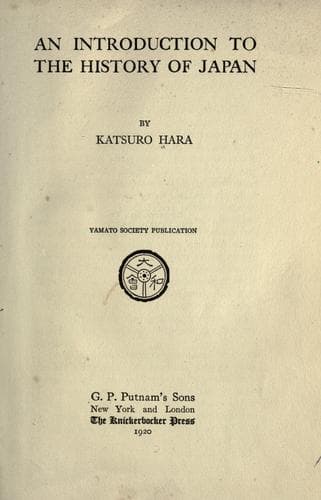
An Introduction to the History of JapanHara, Katsuro
History
An Introduction to the History of Japan
Hara, Katsuro
Japan -- History
Without doubt Japan under the Tokugawa Shogunate was a country governed
by a military regime, feudalistic in form, but in truth peace brooded
over the land, the utmost peace which could be expected from any
military regime. As tranquillity had continued so long, our civilisation
had been able meanwhile to make a wonderful progress. If war can be
eulogised with some justice to be a stimulating and compulsive factor of
civilisation, with no less certainty peace may be complimented as a
factor, the most efficient, in fostering the same. In the preceding
chapters I have spoken of the propagation of culture throughout the
country, notwithstanding its anarchical condition, and of that very
culture, which was in the main humanistic. This humanistic culture had
now its successor in a civilisation higher in form and in quality. That
the progress was apparently retarded for a while on account of wars,
which rapidly succeeded one after another at the end of the Ashikaga,
was a phenomenon that was only temporary. How could a few patches of
straw floating on the surface stop the forward movement of a strong
undercurrent, however slowly the stream might run? Mingled with the
clash and clang of arms, an exquisite music embodying the ever advancing
civilisation of our country had been heard; though at first very faintly
audible, it grew louder and louder till it became sonorous enough to
make the whole nation vibrate when the clamorous battle-cry of the
warriors had subsided. In short, Japan had been steadily advancing, and
it was indeed those warriors themselves who carried the torch of
civilisation farther and farther onward. Many historians ascribed it
solely to the individual exertion of Iyeyasu, that learning had been
revived since the beginning of the seventeenth century. Seeing, however,
that those _samurai_ who fought with and under him had rarely been noted
for the excellence of their literary acquirements, it can hardly be
supposed that he had been deeply interested in promoting learning and
culture among his entourage. Neither did he himself leave any trace of
his having received a higher degree of liberal education than the
average generals of his times. It is too notorious a fact to doubt that
he earnestly encouraged learning and ordered many books to be
reprinted. Yet it is also clear that his encouragement was very
efficient, mainly because his position as the sole military and
political master of Japan enabled him to figure as a patron of the arts.
The fact that before his authority as a military dictator became
incontestably established, the reprint of various books had been going
on almost without intermission, and that the two Emperors Go-Yozei and
Go-Midzunowo and also Kanetsugu Naoye, a warrior who had grown up in the
remote province of Yechigo, were among the most ardent patrons of
learning by the encouragement they gave to the reprinting of standard
works, testifies that Iyeyasu did not stand alone in encouraging liberal
education.
Public-domain text, read in full here on John Shaqi.
Reviews
Reviews
No reviews yet
Be the first to share your thoughts on this work.
Elsewhere in the archive
Join the Discussion
Join the discussion
Sign in to leave a comment or review.
Sign InorCreate an account