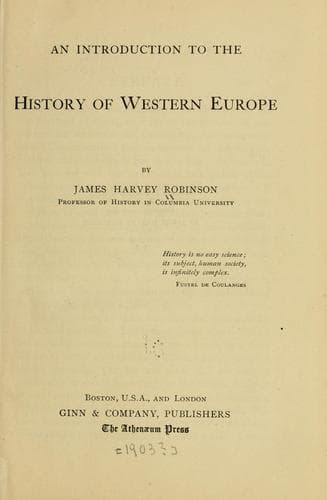
An Introduction to the History of Western Europe — John Shaqi
An Introduction to the History of Western EuropeRobinson, James Harvey
History
An Introduction to the History of Western Europe
Robinson, James Harvey
Europe -- History
Let us first glance at the government and the emperor. His decrees were
dispatched throughout the length and breadth of the Roman dominions;
whatsoever pleased him became law, according to the well-known principle
of the Roman constitution. While the cities were permitted some freedom
in the regulation of their purely local affairs, the emperor and his
innumerable and marvelously organized officials kept an eye upon even
the humblest citizen. The Roman government, besides maintaining order,
administering justice, and defending the boundaries, assumed many other
responsibilities. It watched the grain dealers, butchers, and bakers;
saw that they properly supplied the public and never deserted their
occupation. In some cases it forced the son to follow the profession of
his father. If it could have had its way, it would have had every one
belong to a definite class of society, and his children after him. It
kept the unruly poorer classes quiet in the towns by furnishing them
with bread, and sometimes with wine, meat, and clothes. It provided
amusement for them by expensive entertainments, such as races and
gladiatorial combats. In a word, the Roman government was not only
wonderfully organized, so that it penetrated to the utmost confines of
its territory, but it attempted to guard and regulate almost every
interest in life.
[Sidenote: The worship of the emperor.]
Every one was required to join in the worship of the emperor because he
stood for the majesty of the Roman dominion. The inhabitants of each
province might revere their particular gods, undisturbed by the
government, but all were obliged as good citizens to join in the
official sacrifices to the deified head of the state. The early
Christians were persecuted, not only because their religion was
different from that of their fellows, but because they refused to offer
homage to the image of the emperor and openly prophesied the downfall of
the Roman state. Their religion was incompatible with what was then
deemed good citizenship, inasmuch as it forbade them to express the
required veneration for the government.
[Sidenote: The Roman law.]
Public-domain text, read in full here on John Shaqi.
Reviews
Reviews
No reviews yet
Be the first to share your thoughts on this work.
Join the Discussion
Join the discussion
Sign in to leave a comment or review.
Sign InorCreate an account