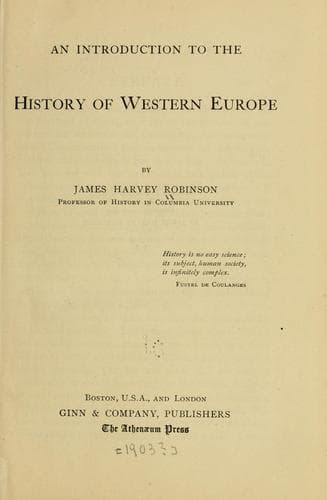
An Introduction to the History of Western EuropeRobinson, James Harvey
History
An Introduction to the History of Western Europe
Robinson, James Harvey
Europe -- History
As there was one government, so there was one law for all the civilized
world. Local differences were not considered; the same principles of
reason, justice, and humanity were believed to hold whether the Roman
citizen lived upon the Euphrates or the Thames. The law of the Roman
Empire is its chief legacy to posterity. Its provisions are still in
force in many of the states of Europe to-day, and it is one of the
subjects of study in our American universities. It exhibited a humanity
unknown to the earlier legal codes. The wife, mother, and infant were
protected from the arbitrary power of the head of the house, who, in
earlier centuries, had been privileged to treat the members of his
family as slaves. It held that it was better that a guilty person should
escape than that an innocent person should be condemned. It conceived
humanity, not as a group of nations and tribes, each with its peculiar
institutions and legal customs, but as one people included in one great
empire and subject to a single system of law based upon reason and
equity.
[Illustration: A Fortified Roman Gateway at Treves]
[Sidenote: Roads and public works.]
Magnificent roads were constructed, which enabled the messengers of the
government and its armies to reach every part of the Empire with
incredible speed. These highways made commerce easy and encouraged
merchants and travelers to visit the most distant portions of the realm.
Everywhere they found the same coins and the same system of weights and
measures. Colonies were sent out to the confines of the Empire, and the
remains of great public buildings, of theaters and bridges, of sumptuous
villas and baths at places like Treves, Cologne, Bath, and Salzburg
indicate how thoroughly the influence and civilization of Rome
penetrated to the utmost parts of the territory subject to her rule.
[Sidenote: The same culture throughout the Roman Empire.]
The government encouraged education by supporting at least three
teachers in every town of any considerable importance. They taught
rhetoric and oratory and explained the works of the great writers. The
Romans, who had no marked literary or artistic ability, had adopted the
culture of the Greeks. This was spread abroad by the government teachers
so that an educated man was pretty sure to find, even in the outlying
parts of the great Empire, other educated men with much the same
interests and ideas as his own. Everywhere men felt themselves to be not
mere natives of this or that land but citizens of the world.
[Sidenote: Loyalty to the Empire and conviction that it was eternal.]
Public-domain text, read in full here on John Shaqi.
Reviews
Reviews
No reviews yet
Be the first to share your thoughts on this work.
Join the Discussion
Join the discussion
Sign in to leave a comment or review.
Sign InorCreate an account