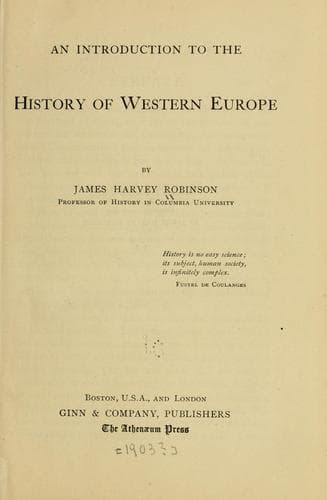
An Introduction to the History of Western EuropeRobinson, James Harvey
History
An Introduction to the History of Western Europe
Robinson, James Harvey
Europe -- History
Although scarcely more than a boy in years, Charles had already begun to
take life very seriously. He had decided that Spain, not Germany, was to
be the bulwark and citadel of all his realms. Like the more enlightened
of his Spanish subjects, he realized the need of reforming the Church,
but he had no sympathy whatever with any change of doctrine. He
proposed to live and die a devout Catholic of the old type, such as his
orthodox ancestors had been. He felt, moreover, that he must maintain
the same religion in all parts of his heterogeneous dominions. If he
should permit the Germans to declare their independence of the Church,
the next step would be for them to claim that they had a right to
regulate their government regardless of their emperor.
[Sidenote: Luther summoned to the diet at Worms.]
Upon arriving at Worms the case of Luther was at once forced upon
Charles' attention by the assiduous papal representative, Aleander, who
was indefatigable in urging him to outlaw the heretic without further
delay. While Charles seemed convinced of Luther's guilt, he could not
proceed against him without serious danger. The monk had become a
national hero and had the support of the powerful elector of Saxony.
Other princes, who had ordinarily no wish to protect a heretic, felt
that Luther's denunciation of the evils in the Church and of the actions
of the pope was very gratifying. After much discussion it was finally
arranged, to the great disgust of the zealous Aleander, that Luther
should be summoned to Worms and be given an opportunity to face the
German nation and the emperor, and to declare plainly whether he was the
author of the heretical books ascribed to him, and whether he still
adhered to the doctrines which the pope had declared wrong.
The emperor accordingly wrote the "honorable and respected" Luther a
very polite letter, ordering him to appear at Worms and granting him a
safe-conduct thither. Luther said, on receiving the summons, that if he
was going to Worms merely to retract, he might better stay in
Wittenberg, where he could, if he would, abjure his errors quite as well
as on the Rhine. If, on the other hand, the emperor wished him to come
to Worms in order that he might be put to death, he was quite ready to
go, "for, with Christ's help, I will not flee and leave the Word in the
lurch. My revocation will be in this wise: 'Earlier I said that the
pope was God's vicar; now I revoke and say, the pope is Christ's enemy
and an envoy of the devil.'"
148. Luther accordingly set out for Worms accompanied by the imperial
herald. He enjoyed a triumphal progress through the various places on
his way and preached repeatedly, in spite of the fact that he was an
excommunicated heretic. He found the diet in a great state of commotion.
The papal representative was the object of daily insults, and Hutten and
Sickingen talked of scattering Luther's enemies by a sally from the
neighboring castle of Ebernburg.
[Sidenote: Luther before the diet.]
Public-domain text, read in full here on John Shaqi.
Reviews
Reviews
No reviews yet
Be the first to share your thoughts on this work.
Elsewhere in the archive
Join the Discussion
Join the discussion
Sign in to leave a comment or review.
Sign InorCreate an account