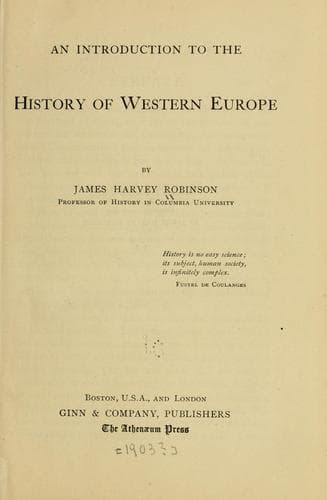
An Introduction to the History of Western EuropeRobinson, James Harvey
History
An Introduction to the History of Western Europe
Robinson, James Harvey
Europe -- History
It was not proposed to give Luther an opportunity to defend his beliefs
before the diet. When he appeared before "emperor and empire," he was
simply asked if a pile of his Latin and German works were really his,
and, if so, whether he revoked what he had said in them. To the first
question the monk replied in a low voice that he had written these and
more. As to the second question, which involved the welfare of the soul
and the Word of God, he asked that he might have a little while to
consider.
The following day, in a Latin address which he repeated in German, he
admitted that he had been overviolent in his attacks upon his opponents;
but he said that no one could deny that, through the popes' decrees, the
consciences of faithful Christians had been miserably ensnared and
tormented, and their goods and possessions, especially in Germany,
devoured. Should he recant those things which he had said against the
pope's conduct he would only strengthen the papal tyranny and give an
opportunity for new usurpations. If, however, adequate arguments against
his position could be found in the Scriptures, he would gladly and
willingly recant. He could not, however, accept the decision either of
pope or of council, since both, he believed, had made mistakes and
contradicted themselves. "I must," he concluded, "allow my conscience
to be controlled by God's Word. Recant I can not and will not, for it is
hazardous and dishonorable to act against one's conscience."
[Sidenote: The emperor forced by the law to outlaw Luther.]
There was now nothing for the emperor to do but to outlaw Luther, who
had denied the binding character of the commands of the head of the
Church and of the highest Christian tribunal, a general council. His
argument that the Scriptures sustained him in his revolt could not be
considered by the diet.[282]
[Sidenote: The Edict of Worms, 1521.]
Aleander was accordingly assigned the agreeable duty of drafting the
famous Edict of Worms. This document declared Luther an outlaw on the
following grounds: that he disturbed the recognized number and
celebration of the sacraments, impeached the regulations in regard to
marriage, scorned and vilified the pope, despised the priesthood and
stirred up the laity to dip their hands in the blood of the clergy,
denied free will, taught licentiousness, despised authority, advocated a
brutish existence, and was a menace to Church and State alike. Every one
was forbidden to give the heretic food, drink, or shelter, and required
to seize him and deliver him to the emperor.
Public-domain text, read in full here on John Shaqi.
Reviews
Reviews
No reviews yet
Be the first to share your thoughts on this work.
Elsewhere in the archive
Join the Discussion
Join the discussion
Sign in to leave a comment or review.
Sign InorCreate an account