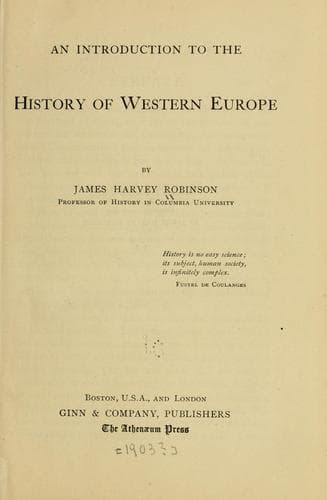
An Introduction to the History of Western EuropeRobinson, James Harvey
History
An Introduction to the History of Western Europe
Robinson, James Harvey
Europe -- History
Moreover, the decree provides that "no one shall dare to buy, sell,
read, preserve, copy, print, or cause to be copied or printed any books
of the aforesaid Martin Luther, condemned by our holy father the pope,
as aforesaid, or any other writings in German or Latin hitherto composed
by him, since they are foul, noxious, suspected, and published by a
notorious and stiff-necked heretic. Neither shall any one dare to affirm
his opinions, or proclaim, defend, or advance them in any other way
that human ingenuity can invent,--notwithstanding that he may have put
some good into his writings in order to deceive the simple man."[283]
For the last time the empire had recognized its obligation to carry out
the decrees of the Bishop of Rome. "I am becoming ashamed of my
fatherland," Hutten cried. So general was the disapproval of the edict
that few were willing to pay any attention to it. Charles immediately
left Germany, and for nearly ten years was occupied outside it with the
government of Spain and a succession of wars.
General Reading.--BEARD, _Martin Luther_ (see above, p. 386), is
probably the best account in English of Luther before his
retirement to the Wartburg; KÖSTLIN, _Life of Luther_ (Scribner's
Sons, $2.50), is excellent. An account of Luther and Hutten by a
learned Roman Catholic writer may be found in JANSSEN, _History of
the German People_ (see above, p. 386), Vol. III; CREIGHTON,
_History of the Papacy_ (see above, p. 320), Vol. VI; Chapters III
and V are devoted to Luther and the diet of Worms.
CHAPTER XXVI
COURSE OF THE PROTESTANT REVOLT IN GERMANY
1521-1555
[Sidenote: Luther begins a new translation of the Bible in the
Wartburg.]
149. As Luther neared Eisenach upon his way home from Worms he was
seized by a band of men and conducted to the Wartburg, a castle
belonging to the elector of Saxony. Here he was concealed until any
danger from the action of the emperor or diet should pass by. His chief
occupation during several months of hiding was to begin a new
translation of the Bible into German. He had finished the New Testament
before he left the Wartburg in March, 1522.
Up to this time, German editions of the Scriptures, while not uncommon,
were poor and obscure. Luther's task was a difficult one. He said with
truth that "translation is not an art to be practiced by every one; it
demands a right pious, true, industrious, reverent, Christian,
scholarly, experienced, and well-trained mind." He had studied Greek for
only two or three years, and he knew far less Hebrew than Greek.
Moreover, there was no generally accepted form of the German language of
which he could make use. Each region had its peculiar dialect which
seemed outlandish to the neighboring district.
[Sidenote: Luther's Bible the first important book in modern German.]
Public-domain text, read in full here on John Shaqi.
Reviews
Reviews
No reviews yet
Be the first to share your thoughts on this work.
Elsewhere in the archive
Join the Discussion
Join the discussion
Sign in to leave a comment or review.
Sign InorCreate an account