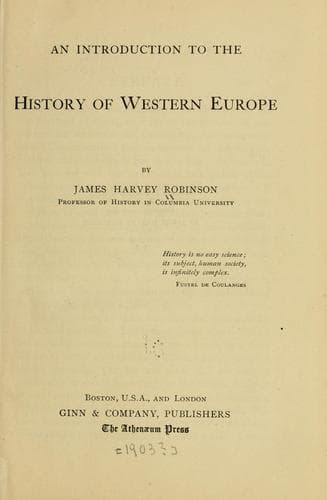
An Introduction to the History of Western EuropeRobinson, James Harvey
History
An Introduction to the History of Western Europe
Robinson, James Harvey
Europe -- History
He was anxious above all that the Bible should be put into language that
would seem perfectly clear and natural to the common folk. So he went
about asking the mothers and children and the laborers questions which
might draw out the expression that he was looking for. It sometimes took
him two or three weeks to find the right word. But so well did he do
his work that his Bible may be regarded as a great landmark in the
history of the German language. It was the first book of any importance
written in modern German, and it has furnished an imperishable standard
for the language.
[Sidenote: General discussion of public questions in pamphlets and
satires.]
Previous to 1518 there had been very few books or pamphlets printed in
German. The translation of the Bible into language so simple that even
the unlearned might profit by it was only one of the signs of a general
effort to awaken the minds of the common people. Luther's friends and
enemies also commenced to write for the great German public in its own
language. The common man began to raise his voice, to the scandal of the
learned.
Hundreds of pamphlets, satires, and pictorial caricatures have come down
to us which indicate that the religious and other questions of the day
were often treated in somewhat the same spirit in which our comic papers
deal with political problems and discussions now. We find, for instance,
a correspondence between Leo X and the devil, and a witty dialogue
between Franz von Sickingen and St. Peter at the gate of heaven. In the
latter Peter confesses that he has never heard of the right "to loose
and to bind," of which his successors say so much. He refuses to discuss
military matters with Sickingen, but calls in St. George, who is
supposed to be conversant with the art of war. In another satire, a
vacation visit of St. Peter to the earth is described. He is roughly
treated, especially by the soldiers at an inn, and hastens back to
heaven with a sad tale of the evil plight of Germany, of how badly
children are brought up, and how unreliable the servants are.[284]
[Sidenote: Divergent notions of how the Church should actually be
reformed.]
Public-domain text, read in full here on John Shaqi.
Reviews
Reviews
No reviews yet
Be the first to share your thoughts on this work.
Elsewhere in the archive
Join the Discussion
Join the discussion
Sign in to leave a comment or review.
Sign InorCreate an account