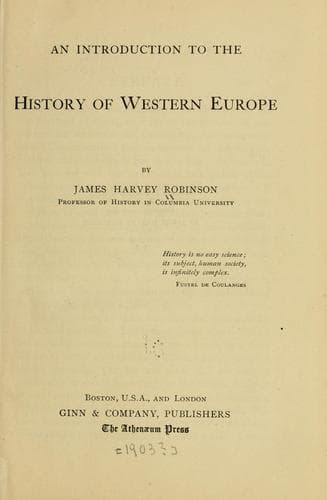
An Introduction to the History of Western EuropeRobinson, James Harvey
History
An Introduction to the History of Western Europe
Robinson, James Harvey
Europe -- History
18. The chief importance of the Church for the student of mediæval
history does not lie, however, in its religious functions, vital as they
were, but rather in its remarkable relations to the civil government. At
first the Church and the imperial government were on a friendly footing
of mutual respect and support. So long as the Roman Empire remained
strong and active there was no chance for the clergy to free themselves
from the control of the emperor, even if they had been disposed to do
so. He made such laws for the Church as he saw fit and the clergy did
not complain. The government was, indeed, indispensable to them. It
undertook to root out paganism by destroying the heathen shrines and
preventing heathen sacrifices, and it harshly punished those who refused
to accept the teachings sanctioned by the Church.
[Sidenote: The Church begins to seek independence.]
But as the barbarians came in and the great Empire began to fall apart,
there was a growing tendency among the churchmen in the West to resent
the interference of rulers whom they no longer respected. They managed
gradually to free themselves in large part from the control of the civil
government. They then proceeded themselves to assume many of the duties
of government, which the weak and disorderly states into which the Roman
Empire fell were unable to perform properly. In 502, a church council at
Rome declared a decree of Odoacer's null and void, on the ground that no
layman had a right to interfere in the affairs of the Church. One of the
bishops of Rome (Pope Gelasius I, d. 496) briefly stated the principle
upon which the Church rested its claims, as follows: "Two powers govern
the world, the priestly and the kingly. The first is indisputably the
superior, for the priest is responsible to God for the conduct of even
the emperors themselves." Since no one denied that the eternal interests
of mankind, which devolved upon the Church, were infinitely more
important than those matters of mere worldly expediency which the state
regulated, it was natural for the clergy to hold that, in case of
conflict, the Church and its officers, rather than the king, should have
the last word.
[Sidenote: The Church begins to perform the functions of government.]
Public-domain text, read in full here on John Shaqi.
Reviews
Reviews
No reviews yet
Be the first to share your thoughts on this work.
Join the Discussion
Join the discussion
Sign in to leave a comment or review.
Sign InorCreate an account