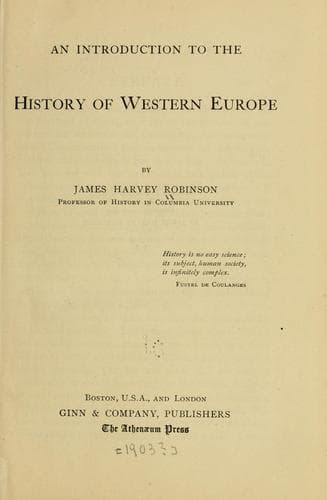
An Introduction to the History of Western EuropeRobinson, James Harvey
History
An Introduction to the History of Western Europe
Robinson, James Harvey
Europe -- History
It was one thing, however, for the Church to claim the right to regulate
its own affairs; it was quite another for it to assume the functions
which the Roman government had previously performed and which our
governments perform to-day, such as the maintenance of order, the
management of public education, the trial of lawsuits, etc. It did not,
however, exactly usurp the prerogatives of the civil power, but rather
offered itself as a substitute for it when no efficient civil government
any longer existed. For there were no states, in the modern sense of the
word, in western Europe for many centuries after the final destruction
of the Roman Empire. The authority of the various kings was seldom
sufficient to keep their realms in order. There were always many
powerful landholders scattered throughout the kingdom who did pretty
much what they pleased and settled their grudges against their fellows
by neighborhood wars. Fighting was the main business as well as the
chief amusement of the noble class. The king was unable to maintain
peace and protect the oppressed, however anxious he may have been to do
so.
Under these circumstances, it naturally fell to the admirably organized
Church to keep order, when it could, by threats or persuasion; to see
that sworn contracts were kept, that the wills of the dead were
administered, and marriage obligations observed. It took the defenseless
widow and orphan under its protection and dispensed charity; it promoted
education at a time when few laymen, however rich and noble, pretended
even to read. These conditions serve to explain why the Church was
finally able greatly to extend the powers which it had enjoyed under the
Roman Empire, and why it undertook functions which seem to us to belong
to the state rather than to a religious organization.
[Sidenote: Origin of papal power.]
19. We must now turn to a consideration of the origin and growth of the
supremacy of the popes, who, by raising themselves to the head of the
Western Church, became in many respects more powerful than any of the
kings and princes with whom they frequently found themselves in bitter
conflict.
[Sidenote: Prestige of the Roman Christian community.]
While we cannot discover, either in the Acts of the Council of Nicæa or
in the Theodosian Code, compiled more than a century later, any
recognition of the supreme headship of the Bishop of Rome, there is
little doubt that he and his flock had almost from the very first
enjoyed a leading place among the Christian communities. The Roman
Church was the only one in the West which could claim the distinction of
having been founded by the immediate followers of Christ,--the "two most
glorious apostles."
[Sidenote: Belief that Peter was the first Bishop of Rome.]
Public-domain text, read in full here on John Shaqi.
Reviews
Reviews
No reviews yet
Be the first to share your thoughts on this work.
Join the Discussion
Join the discussion
Sign in to leave a comment or review.
Sign InorCreate an account