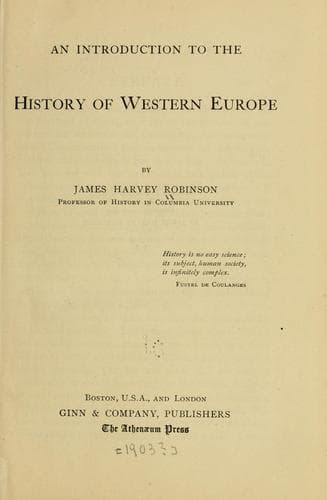
An Introduction to the History of Western Europe — John Shaqi
An Introduction to the History of Western EuropeRobinson, James Harvey
History
An Introduction to the History of Western Europe
Robinson, James Harvey
Europe -- History
We must learn, above all, to study sympathetically institutions and
beliefs that we are tempted at first to declare absurd and unreasonable.
The aim of the historian is not to prove that a particular way of doing
a thing is right or wrong, as, for instance, intrusting the whole
government to a king or forbidding clergymen to marry. His object is to
show as well as he can how a certain system came to be introduced, what
was thought of it, how it worked, and how another plan gradually
supplanted it. It seems to us horrible that a man should be burned alive
because he holds views of Christianity different from those of his
neighbors. Instead, however, of merely condemning the practice, we must,
as historical students, endeavor to see why practically every one in the
thirteenth century, even the wisest and most tender-hearted, agreed that
such a fearful punishment was the appropriate one for a heretic. An
effort has, therefore, been made throughout this volume to treat the
convictions and habits of men and nations in the past with
consideration; that is, to make them seem natural and to show their
beneficent rather than their evil aspects. It is not the weakness of an
institution, but the good that is in it, that leads men to adopt and
retain it.
[Sidenote: Impossibility of dividing the past into clearly defined
periods.]
[Sidenote: All general changes take place gradually.]
2. It is impossible to divide the past into distinct, clearly defined
periods and prove that one age ended and another began in a particular
year, such as 476, or 1453, or 1789. Men do not and cannot change their
habits and ways of doing things all at once, no matter what happens. It
is true that a single event, such as an important battle which results
in the loss of a nation's independence, may produce an abrupt change in
the government. This in turn may encourage or discourage commerce and
industry and modify the language and the spirit of a people. Yet these
deeper changes take place only very gradually. After a battle or a
revolution the farmer will sow and reap in his old way, the artisan will
take up his familiar tasks, and the merchant his buying and selling. The
scholar will study and write and the household go on under the new
government just as they did under the old. So a change in government
affects the habits of a people but slowly in any case, and it may leave
them quite unaltered.
Public-domain text, read in full here on John Shaqi.
Reviews
Reviews
No reviews yet
Be the first to share your thoughts on this work.
Join the Discussion
Join the discussion
Sign in to leave a comment or review.
Sign InorCreate an account