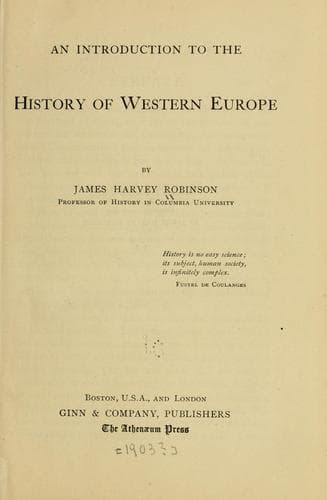
An Introduction to the History of Western Europe — John Shaqi
An Introduction to the History of Western EuropeRobinson, James Harvey
History
An Introduction to the History of Western Europe
Robinson, James Harvey
Europe -- History
The French Revolution, at the end of the eighteenth century, was
probably the most abrupt and thoroughgoing change in the habits of a
nation of which we have any record. But we shall find, when we come to
study it, that it was by no means so sudden in reality as is ordinarily
supposed. Moreover, the innovators did not even succeed in permanently
altering the form of government; for when the French, after living under
a monarchy for many centuries, set up a republic in 1792, the new
government lasted only a few years. The nation was monarchical by habit
and soon gladly accepted the rule of Napoleon, which was more despotic
than that of any of its former kings. In reorganizing the state he
borrowed much from the discarded monarchy, and the present French
republic still retains many of these arrangements.
[Sidenote: The unity or continuity of history.]
This tendency of mankind to do, in general, this year what it did last,
in spite of changes in some one department of life,--such as
substituting a president for a king, traveling by rail instead of on
horseback, or getting the news from a newspaper instead of from a
neighbor,--results in what is called the _unity_ or _continuity of
history_. The truth that no abrupt change has ever taken place in all
the customs of a people, and that it cannot, in the nature of things,
take place, is perhaps the most fundamental lesson that history teaches.
Historians sometimes seem to forget this principle, when they claim to
begin and end their books at precise dates. We find histories of Europe
from 476 to 918, from 1270 to 1492, as if the accession of a capable
German king in 918, or the death of a famous French king in 1270, or the
discovery of America, marked a general change in European affairs. In
reality, however, no general change took place at these dates or in any
other single year. It would doubtless have proved a great convenience to
the readers and writers of history if the world had agreed to carry out
a definite programme and alter its habits at precise dates, preferably
at the opening of each century. But no such agreement has ever been
adopted, and the historical student must take things as he finds them.
He must recognize that nations retain their old customs while they adopt
new ones, and that a portion of a nation may advance while a great part
of it stays behind.
[Sidenote: Meaning of the term 'Middle Ages.']
Public-domain text, read in full here on John Shaqi.
Reviews
Reviews
No reviews yet
Be the first to share your thoughts on this work.
Join the Discussion
Join the discussion
Sign in to leave a comment or review.
Sign InorCreate an account