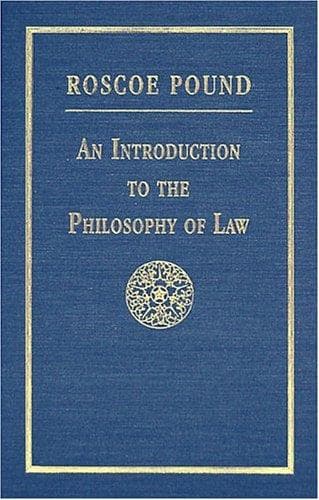
An Introduction to the Philosophy of LawPound, Roscoe
Philosophy
An Introduction to the Philosophy of Law
Pound, Roscoe
Law -- Philosophy
But the theory of natural law, devised for a society organized on the
basis of kinship and developed for a society organized on the basis of
relations, did not suffice for a society which conceived of itself as
an aggregate of individuals and was reorganizing on the basis of
competitive self-assertion. Again the convenient ambiguity of _ius_,
which could mean not only right and law but "a right," was pressed
into service and _ius naturale_ gave us natural rights. The ultimate
thing was not natural law as before, not merely principles of eternal
validity, but natural rights, certain qualities inherent in man and
demonstrated by reason, which natural law exists to secure and to
which positive law ought to give effect. Later these natural rights
came to be the bane of juristic thinking. Yet they achieved great
things in their day. Under the influence of this theory jurists worked
out a scheme of "legal rights" that effectively secures almost the
whole field of individual interests of personality and individual
interests of substance. It put a scientific foundation under the
medieval scheme of the claims and duties involved in the relation of
king to tenants in chief, out of which the judges had developed the
immemorial rights of Englishmen, and enabled the common-law rights of
Englishmen to become the natural rights of man, intrenched as such in
our bills of rights. Thus it served as a needed check upon the
exuberance of growth stimulated by the theory of natural law. It kept
a certain needed rigidity in a time when law threatened to become
wholly fluid. And this steadying influence was strengthened from
another quarter. The Roman jurisconsult was teacher, philosopher and
practitioner in one. As a lawyer he had the exigencies of the general
security ever before him in that he felt the imperative need of being
able to advise with assurance what tribunals would do on a given state
of facts. The seventeenth- and eighteenth-century jurists were chiefly
teachers and philosophers. Happily they had been trained to accept
the Roman law as something of paramount authority and so were able to
give natural law a content by assuming its identity with an ideal form
of the law which they knew and in which they had been trained. As the
Roman jurisconsult built in the image of the old law of the city, they
built on idealized Roman lines. If Roman law could no longer claim to
be embodied authority, they assumed that, corrected in its details by
a juristic-philosophical critique, it was embodied reason.
Public-domain text, read in full here on John Shaqi.
Reviews
Reviews
No reviews yet
Be the first to share your thoughts on this work.
Join the Discussion
Join the discussion
Sign in to leave a comment or review.
Sign InorCreate an account