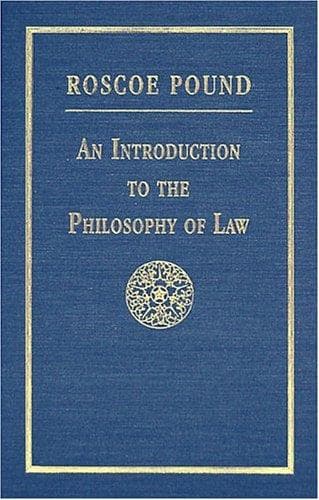
An Introduction to the Philosophy of Law — John Shaqi
An Introduction to the Philosophy of LawPound, Roscoe
Philosophy
An Introduction to the Philosophy of Law
Pound, Roscoe
Law -- Philosophy
Both of these ideas, natural rights and an ideal form of the actual
law of the time and place as the jural order of nature, were handed
down to and put to new uses in the nineteenth century. In the growing
law of the seventeenth and eighteenth centuries they were but guides
to lead growth into definite channels and insure continuity and
permanence in the development of rules and doctrines. Whether natural
rights were conceived as qualities of the natural man or as deductions
from a compact which expressed the nature of man, the point was, not
that the jurist should keep his hands off lest by devising some new
precept or in reshaping some old doctrine he infringe a fundamental
right, but that he should use his hand freely and skilfully to shape
rules and doctrines and institutions that they might be instruments of
achieving the ideal of human existence in a "state of nature." For the
state of nature, let us remember, was a state which expressed the
ideal of man as a rational creature. If a reaction from the formal
over-refinement of the eighteenth century came to identify this with
a primitive simplicity, in juristic hands it was the simplicity of a
rational ideal in place of the cumbrous complexity of legal systems
which had become fixed in their ideas in the stage of the strict
law. Thus Pothier, discussing the Roman categories of contract and
rejecting them for the "natural" principle that man, as a moral
creature, should keep his engagements, declares that the complex and
arbitrary system of Roman law, made up of successive additions at
different times to a narrow primitive stock of legally enforceable
promises, is not adhered to because it is "remote from simplicity."
Again the ideal form of the actual law, which gave content to
natural law, was not an ideal form of historically found principles,
constraining development for all time within historically fixed
bounds, as in the nineteenth century, but an ideal form of the _ratio
legis_--of the reason behind the rule or doctrine or institution
whereby it expressed the nature of the rational human being guided
only by reason and conscience in his relations with similar beings
similarly guided. Attempts to fix the immutable part of law, to lay
out legal charts for all time, belong to the transition to the
maturity of law. The eighteenth-century projects for codification and
the era of codification on the Continent, in which the results of two
centuries of growth were put in systematic form to serve as the basis
of a juristic new start, in form rested upon the theory of natural
law. By a sheer effort of reason the jurist could work out a complete
system of deductions from the nature of man and formulate them in a
perfect code. Go to, let him do so! This was not the mode of thought
of a period of growth but rather of one when growth had been achieved
and the philosophical theory of a law of nature was called upon for a
new kind of service.
Public-domain text, read in full here on John Shaqi.
Reviews
Reviews
No reviews yet
Be the first to share your thoughts on this work.
Join the Discussion
Join the discussion
Sign in to leave a comment or review.
Sign InorCreate an account