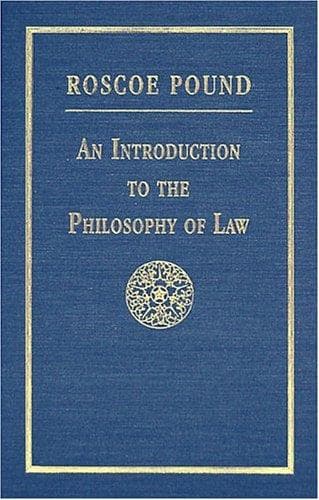
An Introduction to the Philosophy of Law — John Shaqi
An Introduction to the Philosophy of LawPound, Roscoe
Philosophy
An Introduction to the Philosophy of Law
Pound, Roscoe
Law -- Philosophy
Second, there is an idea of law as a tradition of the old customs
which have proved acceptable to the gods and hence point the way in
which man may walk with safety. For primitive man, surrounded by what
seem vengeful and capricious powers of nature, is in continual fear of
giving offence to these powers and thus bringing down their wrath upon
himself and his fellows. The general security requires that men do
only those things and do them only in the way which long custom has
shown at least not displeasing to the gods. Law is the traditional or
recorded body of precepts in which that custom is preserved and
expressed. Whenever we find a body of primitive law possessed as a
class tradition by a political oligarchy it is likely to be thought of
in this way just as a body of like tradition in the custody of a
priesthood is certain to be thought of as divinely revealed.
A third and closely related idea conceives of law as the recorded
wisdom of the wise men of old who had learned the safe course or the
divinely approved course for human conduct. When a traditional custom
of decision and custom of action has been reduced to writing in a
primitive code it is likely to be thought of in this way, and
Demosthenes in the fourth century B. C. could describe the law of
Athens in these terms.
Fourth, law may be conceived as a philosophically discovered system of
principles which express the nature of things, to which, therefore,
man ought to conform his conduct. Such was the idea of the Roman
jurisconsult, grafted, it is true, on the second and third ideas and
on a political theory of law as the command of the Roman people, but
reconciled with them by conceiving of tradition and recorded wisdom
and command of the people as mere declarations or reflections of the
philosophically ascertained principles, to be measured and shaped and
interpreted and eked out thereby. In the hands of philosophers the
foregoing conception often takes another form so that, fifth, law is
looked upon as a body of ascertainments and declarations of an eternal
and immutable moral code.
Sixth, there is an idea of law as a body of agreements of men in
politically organized society as to their relations with each other.
This is a democratic version of the identification of law with rules
of law and hence with the enactments and decrees of the city-state
which is discussed in the Platonic Minos. Not unnaturally Demosthenes
suggests it to an Athenian jury. Very likely in such a theory a
philosophical idea would support the political idea and the inherent
moral obligation of a promise would be invoked to show why men should
keep the agreements made in their popular assemblies.
Public-domain text, read in full here on John Shaqi.
Reviews
Reviews
No reviews yet
Be the first to share your thoughts on this work.
Join the Discussion
Join the discussion
Sign in to leave a comment or review.
Sign InorCreate an account