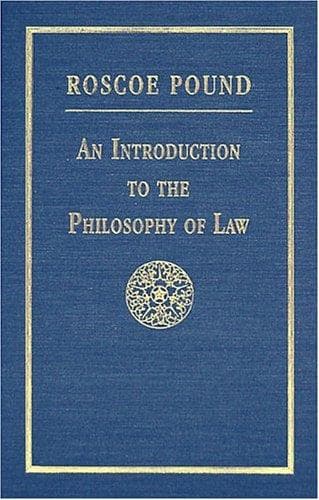
An Introduction to the Philosophy of LawPound, Roscoe
Philosophy
An Introduction to the Philosophy of Law
Pound, Roscoe
Law -- Philosophy
Seventh, law has been thought of as a reflection of the divine reason
governing the universe; a reflection of that part which determines the
"ought" addressed by that reason to human beings as moral entities, in
distinction from the "must" which it addresses to the rest of
creation. Such was the conception of Thomas Aquinas, which had great
currency down to the seventeenth century and has had much influence
ever since.
Eighth, law has been conceived as a body of commands of the sovereign
authority in a politically organized society as to how men should
conduct themselves therein, resting ultimately on whatever basis was
held to be behind the authority of that sovereign. So thought the
Roman jurists of the Republic and of the classical period with respect
to positive law. And as the emperor had the sovereignty of the Roman
people devolved upon him, the Institutes of Justinian could lay down
that the will of the emperor had the force of a law. Such a mode of
thought was congenial to the lawyers who were active in support of
royal authority in the centralizing French monarchy of the sixteenth
and seventeenth centuries and through them passed into public law. It
seemed to fit the circumstances of parliamentary supremacy in England
after 1688, and became the orthodox English juristic theory. Also it
could be made to fit a political theory of popular sovereignty in
which the people were thought of as succeeding to the sovereignty of
parliament at the American Revolution or of the French king at the
French Revolution.
A ninth idea of law takes it to be a system of precepts discovered by
human experience whereby the individual human will may realize the
most complete freedom possible consistently with the like freedom of
will of others. This idea, held in one form or another by the
historical school, divided the allegiance of jurists with the theory
of law as command of the sovereign during almost the whole of the past
century. It assumed that the human experience by which legal
principles were discovered was determined in some inevitable way. It
was not a matter of conscious human endeavor. The process was
determined by the unfolding of an idea of right and justice or an idea
of liberty which was realizing itself in human administration of
justice, or by the operation of biological or psychological laws or of
race characters, whose necessary result was the system of law of the
time and people in question.
Public-domain text, read in full here on John Shaqi.
Reviews
Reviews
No reviews yet
Be the first to share your thoughts on this work.
Join the Discussion
Join the discussion
Sign in to leave a comment or review.
Sign InorCreate an account