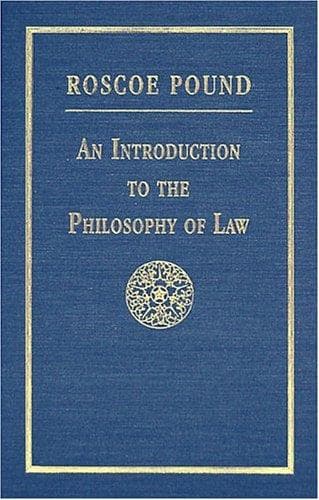
An Introduction to the Philosophy of Law — John Shaqi
An Introduction to the Philosophy of LawPound, Roscoe
Philosophy
An Introduction to the Philosophy of Law
Pound, Roscoe
Law -- Philosophy
Again, tenth, men have thought of law as a system of principles,
discovered philosophically and developed in detail by juristic writing
and judicial decision, whereby the external life of man is measured by
reason, or in another phase, whereby the will of the individual in
action is harmonized with those of his fellow men. This mode of
thought appeared in the nineteenth century after the natural-law
theory in the form in which it had prevailed for two centuries had
been abandoned and philosophy was called upon to provide a critique
for systematic arrangement and development of details.
Eleventh, law has been thought of as a body or system of rules imposed
on men in society by the dominant class for the time being in
furtherance, conscious or unconscious, of its own interest. This
economic interpretation of law takes many forms. In an idealistic form
it thinks of the inevitable unfolding of an economic idea. In a
mechanical sociological form it thinks of class struggle or a struggle
for existence in terms of economics, and of law as the result of the
operation of forces or laws involved in or determining such
struggles. In a positivist-analytical form it thinks of law as the
command of the sovereign, but of that command as determined in its
economic content by the will of the dominant social class, determined
in turn by its own interest. All of these forms belong to transition
from the stability of the maturity of law to a new period of growth.
When the idea of the self-sufficiency of law gives way and men seek to
relate jurisprudence to the other social sciences, the relation to
economics challenges attention at once. Moreover in a time of copious
legislation the enacted rule is easily taken as the type of legal
precept and an attempt to frame a theory of legislative lawmaking is
taken to give an account of all law.
Finally, twelfth, there is an idea of law as made up of the dictates
of economic or social laws with respect to the conduct of men in
society, discovered by observation, expressed in precepts worked out
through human experience of what would work and what not in the
administration of justice. This type of theory likewise belongs to the
end of the nineteenth century, when men had begun to look for
physical or biological bases, discoverable by observation, in place of
metaphysical bases, discoverable by philosophical reflection. Another
form finds some ultimate social fact by observation and develops the
logical implications of that fact much after the manner of the
metaphysical jurist. This again results from the tendency in recent
years to unify the social sciences and consequent attention to
sociological theories.
Public-domain text, read in full here on John Shaqi.
Reviews
Reviews
No reviews yet
Be the first to share your thoughts on this work.
Join the Discussion
Join the discussion
Sign in to leave a comment or review.
Sign InorCreate an account