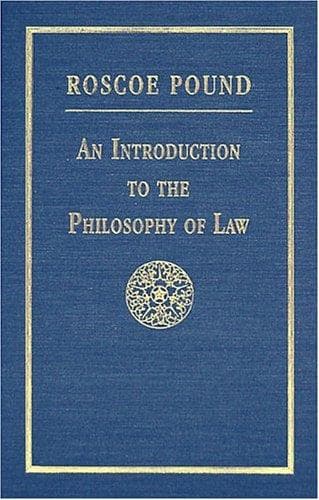
An Introduction to the Philosophy of Law — John Shaqi
An Introduction to the Philosophy of LawPound, Roscoe
Philosophy
An Introduction to the Philosophy of Law
Pound, Roscoe
Law -- Philosophy
Roman lawyers made the Greek philosophical conception into a juristic
theory. For the famous three precepts to which the law is reduced in
Justinian's Institutes come to this: Everyone is to live honorably; he
is to "preserve moral worth in his own person" by conforming to the
conventions of the social order. Everyone is to respect the
personality of others; he is not to interfere with those interests and
powers of action, conceded to others by the social order, which make
up their legal personality. Everyone is to render to everyone else his
own; he is to respect the acquired rights of others. The social system
has defined certain things as belonging to each individual. Justice is
defined in the Institutes as the set and constant purpose of giving
him these things. It consists in rendering them to him and in not
interfering with his having and using them within the defined limits.
This is a legal development of the Greek idea of harmoniously
maintaining the social _status quo_. The later eastern empire carried
it to the extreme. Stability was to be secured by rigidly keeping
everyone to his trade or calling and his descendants were to follow
him therein. Thus the harmony of society and the social order would
not be disturbed by individual ambition.
In the Middle Ages the primitive idea of law as designed only to keep
the peace came back with Germanic law. But the study of Roman law
presently taught the Roman version of the Greek conception and the
legal order was thought of once more as an orderly maintenance of the
social _status quo_. This conception answered to the needs of medieval
society, in which men had found relief from anarchy and violence in
relations of service and protection and a social organization which
classified men in terms of such relations and required them to be held
to their functions as so determined. Where the Greeks thought of a
stationary society corrected from time to time with reference to its
nature or ideal, the Middle Ages thought of a stationary society
resting upon authority and determined by custom or tradition. To each,
law was a system of precepts existing to maintain this stationary
society as it was.
Public-domain text, read in full here on John Shaqi.
Reviews
Reviews
No reviews yet
Be the first to share your thoughts on this work.
Join the Discussion
Join the discussion
Sign in to leave a comment or review.
Sign InorCreate an account