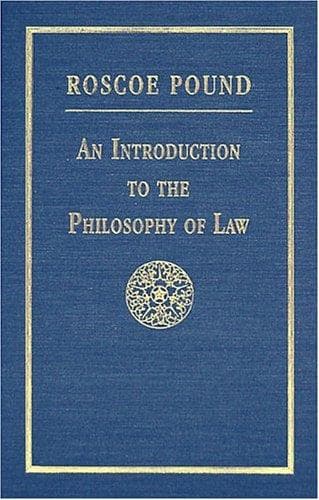
An Introduction to the Philosophy of LawPound, Roscoe
Philosophy
An Introduction to the Philosophy of Law
Pound, Roscoe
Law -- Philosophy
In the feudal social order reciprocal duties involved in relations
established by tradition and taken to rest on authority were the
significant legal institutions. With the gradual disintegration of
this order and the growing importance of the individual in a society
engaged in discovery, colonization and trade, to secure the claims of
individuals to assert themselves freely in the new fields of human
activity which were opening on every side became a more pressing
social want than to maintain the social institutions by which the
system of reciprocal duties was enforced and the relations involving
those duties were preserved. Men did not so much desire that others
perform for them the duties owing in some relation, as that others
keep hands off while they achieved what they might for themselves in a
world that continually afforded new opportunities to the active and
the daring. The demand was no longer that men be kept in their
appointed grooves. Friction and waste were apprehended, not from men
getting out of these grooves, but from attempts to hold them there by
means devised to meet the needs of a different social order whereby
they were made to chafe under arbitrary restraint and their powers
were not utilized in the discovery and exploitation of the resources
of nature, to which human powers were to be devoted in the succeeding
centuries. Accordingly the end of law comes to be conceived as a
making possible of the maximum of individual free self-assertion.
Transition to the newer way of thinking may be seen in the Spanish
jurist-theologians of the sixteenth century. Their juristic theory
was one of natural limits of activity in the relations of individuals
with each other, that is, of limits to human action which expressed
the rational ideal of man as a moral creature and were imposed upon
men by reason. This theory differs significantly from the idea of
antiquity, although it goes by the old name. The Greeks thought of
a system of limiting men's activities in order that each might be
kept in the place for which he was best fitted by nature--the place
in which he might realize an ideal form of his capacities--and thus
to preserve the social order as it stands or as it shall stand
after a rearrangement. The sixteenth-century jurists of the
Counter-Reformation held that men's activities were naturally limited,
and hence that positive law might and should limit them in the
interest of other men's activities, because all men have freedom of
will and ability to direct themselves to conscious ends. Where
Aristotle thought of inequalities arising from the different worth of
individual men and their different capacities for the things which the
social order called for, these jurists thought of a natural (i.e.,
ideal) equality, involved in the like freedom of will and the like
power of conscious employment of one's faculties inherent in all men.
Hence law did not exist to maintain the social _status quo_ with all
Public-domain text, read in full here on John Shaqi.
Reviews
Reviews
No reviews yet
Be the first to share your thoughts on this work.
Join the Discussion
Join the discussion
Sign in to leave a comment or review.
Sign InorCreate an account