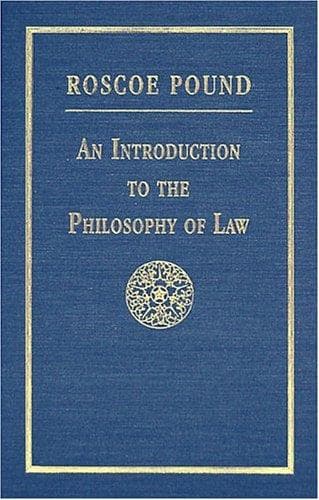
An Introduction to the Philosophy of LawPound, Roscoe
Philosophy
An Introduction to the Philosophy of Law
Pound, Roscoe
Law -- Philosophy
discoverers and colonizers and pioneers and traders and entrepreneurs
and captains of industry. Until the world became crowded, it served
well to eliminate friction and to promote the widest discovery and
utilization of the natural resources of human existence.
Looking back at the history of this conception, which has governed
theories of the end of law for more than two hundred years, we may
note that it has been put to three uses. It has been used as a means
of clearing away the restraints upon free economic activity which
accumulated during the Middle Ages as incidents of the system of
relational duties and as expressions of the idea of holding men to
their place in a static social order. This negative side played an
important part in the English legislative reform movement in the last
century. The English utilitarians insisted upon removal of all
restrictions upon individual free action beyond those necessary for
securing like freedom on the part of others. This, they said, was the
end of legislation. Again it has been used as a constructive idea, as
in the seventeenth and eighteenth centuries, when a commercial law
which gave effect to what men did as they willed it, which looked at
intention and not at form, which interpreted the general security in
terms of the security of transactions and sought to effectuate the
will of individuals to bring about legal results, was developed out of
Roman law and the custom of merchants through juristic theories of
natural law. Finally it was used as a stabilizing idea, as in the
latter part of the nineteenth century, when men proved that law was an
evil, even if a necessary evil, that there should be as little law
made as possible, since all law involved restraint upon free exertion
of the will, and hence that jurist and legislator should be content to
leave things legal as they are and allow the individual "to work out
in freedom his own happiness or misery" on that basis.
Public-domain text, read in full here on John Shaqi.
Reviews
Reviews
No reviews yet
Be the first to share your thoughts on this work.
Join the Discussion
Join the discussion
Sign in to leave a comment or review.
Sign InorCreate an account