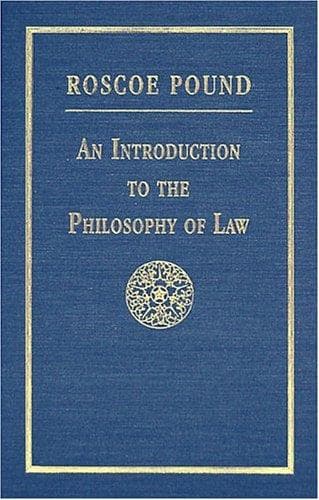
An Introduction to the Philosophy of Law — John Shaqi
An Introduction to the Philosophy of LawPound, Roscoe
Philosophy
An Introduction to the Philosophy of Law
Pound, Roscoe
Law -- Philosophy
its arbitrary restraints on the will and on employment of individual
powers; it existed rather to maintain the natural equality which often
was threatened or impaired by the traditional restrictions on
individual activity. Since this natural equality was conceived
positively as an ideal equality in opportunity to do things, it could
easily pass into a conception of free individual self-assertion as the
thing sought, and of the legal order as existing to make possible the
maximum thereof in a world abounding in undiscovered resources,
undeveloped lands and unharnessed natural forces. The latter idea took
form in the seventeenth century and prevailed for two centuries
thereafter, culminating in the juristic thought of the last
generation.
Law as a securing of natural equality became law as a securing of
natural rights. The nature of man was expressed by certain qualities
possessed by him as a moral, rational creature. The limitations on
human activity, of which the Spanish jurist-theologians had written,
got their warrant from the inherent moral qualities of men which made
it right for them to have certain things and do certain things. These
were their natural rights and the law existed simply to protect and
give effect to these rights. There was to be no restraint for any
other purpose. Except as they were to be compelled to respect the
rights of others, which the natural man or ideal man would do without
compulsion as a matter of reason, men were to be left free. In the
nineteenth century this mode of thought takes a metaphysical turn. The
ultimate thing for juristic purposes is the individual consciousness.
The social problem is to reconcile conflicting free wills of conscious
individuals independently asserting their wills in the varying
activities of life. The natural equality becomes an equality in
freedom of will. Kant rationalized the law in these terms as a system
of principles or universal rules, to be applied to human action,
whereby the free will of the actor may co-exist along with the free
will of everyone else. Hegel rationalized the law in these terms as a
system of principles wherein and whereby the idea of liberty was
realizing in human experience. Bentham rationalized it as a body of
rules, laid down and enforced by the state's authority, whereby the
maximum of happiness, conceived in terms of free self-assertion, was
secured to each individual. Its end was to make possible the maximum
of free individual action consistent with general free individual
action. Spencer rationalized it as a body of rules, formulating the
"government of the living by the dead," whereby men sought to promote
the liberty of each limited only by the like liberty of all. In any
of these ways of putting it, the end of law is to secure the greatest
possible general individual self-assertion; to let men do freely
everything they may consistently with a like free doing of everything
they may by their fellow men. This is indeed a philosophy of law for
Public-domain text, read in full here on John Shaqi.
Reviews
Reviews
No reviews yet
Be the first to share your thoughts on this work.
Join the Discussion
Join the discussion
Sign in to leave a comment or review.
Sign InorCreate an account