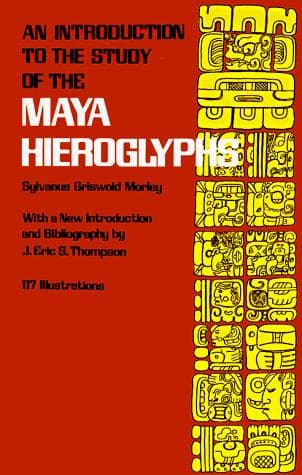
SMITHSONIAN INSTITUTION BUREAU OF AMERICAN ETHNOLOGY BULLETIN 57
AN INTRODUCTION TO THE STUDY OF THE MAYA HIEROGLYPHS
BY
SYLVANUS GRISWOLD MORLEY
[Illustration]
WASHINGTON GOVERNMENT PRINTING OFFICE 1915
* * * * *
{iii}
LETTER OF TRANSMITTAL
SMITHSONIAN INSTITUTION,
BUREAU OF AMERICAN ETHNOLOGY,
_Washington, D. C., January 7, 1914._
Sir: I have the honor to submit the accompanying manuscript of a memoir
bearing the title "An Introduction to the Study of the Maya Hieroglyphs,"
by Sylvanus Griswold Morley, and to recommend its publication as a bulletin
of the Bureau of American Ethnology.
The hieroglyphic writing developed by the Maya of Central America and
southern Mexico was probably the foremost intellectual achievement of
pre-Columbian times in the New World, and as such it deserves equal
attention with other graphic systems of antiquity.
The earliest inscriptions now extant probably date from about the beginning
of the Christian era, but such is the complexity of the glyphs and subject
matter even at this early period, that in order to estimate the age of the
system it is necessary to postulate a far greater antiquity for its origin.
Indeed all that can be accepted safely in this direction is that many
centuries must have elapsed before the Maya hieroglyphic writing could have
been developed to the highly complex stage where we first encounter it.
The first student to make any progress in deciphering the Maya inscriptions
was Prof. Ernst Förstemann, of the Royal Library at Dresden. About 1880
Professor Förstemann published a facsimile reproduction of the Dresden
codex, and for the next twenty years devoted the greater part of his time
to the elucidation of this manuscript. He it was who first discovered and
worked out the ingenious vigesimal system of numeration used by the Maya,
and who first pointed out how this system was utilized to record
astronomical and chronological facts. In short, his pioneer work made
possible all subsequent progress in deciphering Maya texts.
Curiously enough, about the same time, or a little later (in 1891), another
student of the same subject, Mr. J. T. Goodman, of Alameda, California,
working independently and without knowledge of Professor Förstemann's
researches, also succeeded in deciphering the chronological parts of the
Maya texts, and in determining the values of the head-variant numerals. Mr.
Goodman also perfected some {iv} tables, "The Archaic Chronological
Calendar" and "The Archaic Annual Calendar," which greatly facilitate the
decipherment of the calculations recorded in the texts.
Public-domain text, read in full here on John Shaqi.
Reviews
Reviews
No reviews yet
Be the first to share your thoughts on this work.
Join the Discussion
Join the discussion
Sign in to leave a comment or review.
Sign InorCreate an account